Description
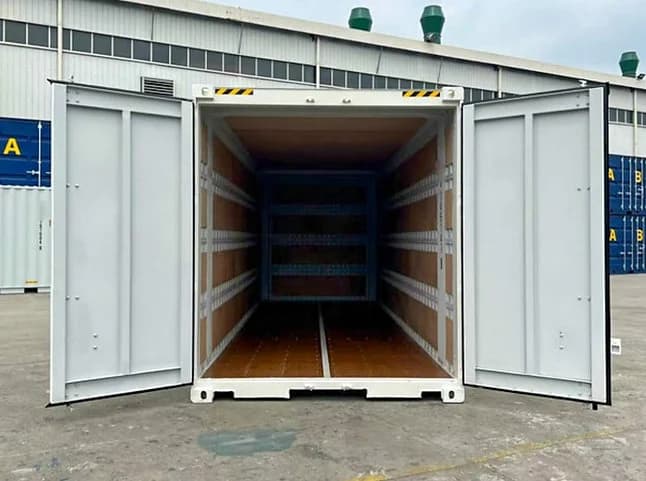
The 25-foot High Cube (HC) mobile container stands out with an interior height greater than standard containers, providing more loading volume. With an external length of approximately 7.64 meters, a width of 2.44 meters, and a height of 2.89 meters, it complies with ISO 668 and 1496 standards, ensuring compatibility with international transport infrastructure. Its High Cube design adds about 30 centimeters of height compared to a standard dry container, resulting in an internal volume of approximately 47.5 cubic meters. This feature is particularly useful for storing bulky goods or optimizing vertical space.
Pallet width is a major asset for logistics professionals. It indicates that the container is specifically designed to optimally accommodate Euro pallets (1200 x 800 mm) or standard pallets (1200 x 1000 mm). With an internal width of approximately 2.35 meters, it is possible to load two pallets side by side along the entire length, maximizing loading efficiency and reducing handling. This configuration is ideal for companies wishing to transport or store palletized goods without wasting space.
The container structure is made of Corten steel, a material recognized for its resistance to corrosion and harsh weather conditions. This type of steel, also known as weathering steel, develops a protective surface layer that limits rust propagation. The floor can be made of treated wood or steel depending on specifications. Treated wood is typically 28 mm thick marine plywood, offering good resistance to moisture and heavy loads. The side walls and roof are made of corrugated steel sheets, ensuring rigidity and relative lightness.
The doors at one end are double doors equipped with sealing gaskets to protect the interior from bad weather. The locking system includes closure bars and secure handles, with the option to add high-security padlocks to enhance theft protection. Ventilation vents are integrated to prevent condensation and protect moisture-sensitive goods. These vents allow minimal but constant air circulation, reducing the risk of mold or degradation.
In terms of weight, the container has an empty weight of approximately 3,500 kg, a maximum payload of approximately 28,000 kg, and a maximum gross weight (empty weight + payload) of approximately 31,500 kg. These values comply with ISO standards and allow safe use in sea, road, or rail transport. It is important to respect these limits to avoid any risk of deformation or accident.
The uses of this container are multiple. It is particularly suitable for transporting palletized goods, whether by sea, road, or rail. Its increased height allows loading taller products or increasing the number of packages per pallet. Additionally, it can serve as temporary or permanent storage on construction sites, in warehouses, or industrial facilities. Logistics companies find it a flexible solution for managing palletized goods flows, while individuals can use it to store bulky equipment.
When purchasing a new container, several points should be checked. Ensure the container comes with a valid CSC (Convention for Safe Containers) certificate, guaranteeing compliance with international safety standards. Check the condition of sealing gaskets, locking bars, and the floor. A new container should have a rust-free surface, clean welds, and uniform paint. The "pallet wide" designation must be confirmed by internal dimensions: an internal width of at least 2.35 meters is necessary to load two pallets side by side.
In France, container transport is subject to regulations on vehicle weights and dimensions. A 25-foot HC container can be transported on a suitable container truck, but it is essential to respect axle load limits and traffic rules. For fixed use (storage), a planning permission may be required depending on duration and location. It is recommended to check with local authorities.
Maintaining a Corten steel container is relatively simple. Regular cleaning with clear water and mild soap removes dirt and preserves the protective layer. Avoid abrasive or acidic products that could damage the paint. Periodically inspect gaskets and vents to ensure they are not obstructed. In case of deep scratches, apply anti-rust paint to prevent corrosion. If the container is used for storing sensitive products, an internal humidity check may be necessary, particularly by installing a dehumidifier.
Compared to a standard 20-foot container, the 25-foot HC offers a superior volume of approximately 47.5 m³ versus 33 m³, an increase of over 40%. This reduces the number of containers needed for the same volume of goods, potentially generating savings on transport and storage costs. Compared to a 40-foot HC, it is more compact and easier to maneuver in tight spaces, while retaining interesting capacity.
In summary, the 25-foot HC mobile container is a versatile solution for transporting and storing palletized goods. Its robust construction, optimized interior height, and pallet width make it a relevant choice for demanding professionals. Whether for logistics, industrial use, or even conversion into a site office, it meets many needs. It is advisable to verify exact specifications with the supplier, particularly regarding internal dimensions and available options.
For deeper maintenance, several levels of intervention should be distinguished. Routine maintenance, to be performed once or twice a year, includes cleaning exterior walls and roof, removing plant debris that could retain moisture, and checking the proper functioning of hinges and locking bars. Light greasing of mechanisms with suitable grease (lithium grease type) extends their lifespan and facilitates operation. More comprehensive preventive maintenance, every two to three years, may include inspection of welds, checking paint condition, and localized touch-ups if necessary. If the container is exposed to a marine environment, inspection frequency should be increased due to salt air accelerating corrosion. In this case, rinsing with fresh water after periods of high exposure is recommended.
Interior maintenance depends on use. For storing dry goods, regular sweeping and checking for leaks are sufficient. For food or pharmaceutical use, stricter cleaning protocols may be required, with approved products. If the container is converted into an office or workspace, insulation and ventilation must be controlled to prevent condensation. Adding flooring or interior wall coverings can facilitate maintenance and improve comfort.
Regarding transport regulations in France, a 25-foot HC container can be transported by truck, train, or ship. For road transport, the vehicle's maximum authorized gross weight (GVWR) and maximum authorized train weight (GCWR) must be respected. A loaded container can reach 31.5 tonnes, requiring a suitable truck and, in some cases, a special permit for exceptional convoys if dimensions or weight exceed regulatory limits. Urban traffic rules may also restrict access to city centers for heavy trucks. Therefore, it is advisable to plan the route according to local regulations.
For sea transport, the container must be CSC certified and comply with International Maritime Organization (IMO) standards. The owner must ensure the container is maintained in good condition and the CSC plate is up to date. For rail transport, the same weight and dimension requirements apply, with specific rules depending on the countries crossed.
If the container is used as a fixed structure (storage, office, housing), it may be subject to building permit regulations. In France, a prior declaration of works may be required for an installation over 20 m² and over 12 meters in height. For temporary use (less than three months), a public domain occupancy permit may be required if the container is placed on public roads. It is recommended to consult the urban planning department of the relevant town hall.
Sector-specific use cases are varied. In agriculture, this container can be used for storing crops, seeds, or equipment, thanks to its ventilation that limits humidity. In construction, it is commonly used as a site office, changing room, or tool storage, appreciated for its robustness and mobility. In events, it can be converted into a control room, booth, or catering space. In retail, it can serve as a pop-up shop or storage. In industry, it is used for storing spare parts or finished products. In the humanitarian sector, it can be shipped to deliver supplies and then serve as an on-site warehouse.
Let's now compare the 25-foot HC to other container types. The standard 20-foot dry container offers a volume of approximately 33 m³ and an internal height of 2.39 meters. The 25-foot HC, with its 47.5 m³ and 2.69 meters height, thus offers a volume approximately 44% greater. The standard 40-foot dry container has a volume of approximately 67 m³, but its length of 12.19 meters can be a drawback for cramped sites. The 25-foot HC represents an interesting compromise between capacity and footprint. The reefer container is designed for transporting perishable goods, with an integrated refrigeration unit, but it is heavier and more expensive. The open top container allows top loading for oversized goods, but it is less watertight. The flat rack is used for heavy or bulky loads that do not fit in a closed container, but it offers no protection against weather. The 25-foot HC, meanwhile, is a closed, versatile container suitable for most palletized goods.
In terms of value for money, the new 25-foot HC is in a competitive price range. Its superior volume reduces the cost per cubic meter transported or stored. Additionally, its Corten steel durability gives it a long lifespan, making it a profitable long-term investment. It is important to note that new containers are generally guaranteed against manufacturing defects, but it is advisable to check the terms with the seller.
For conversion, the 25-foot HC can be transformed into an office, workshop, meeting room, changing room, sanitary facilities, etc. Specialized companies offer conversion kits (insulation, electricity, plumbing, air conditioning). The extra height of the HC facilitates the installation of suspended ceilings and technical ducts. The pallet width allows installing partitions without excessively reducing workspace. It is recommended to use professionals for cutting and structural reinforcement work to ensure the solidity of the whole.
In conclusion, the new 25-foot HC mobile container is a versatile, robust, and functional product. It is aimed at companies and individuals seeking an efficient storage or transport solution for palletized goods. Its simple maintenance, compliance with international standards, and ability to be converted make it a durable choice. Before purchase, it is essential to verify internal dimensions, the presence of the CSC certificate, and general condition. For any specific questions, it is advisable to contact a container professional.