Description
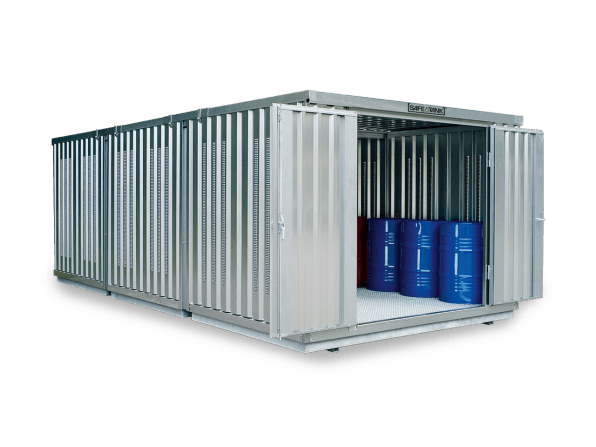
The SRC-S 3.3W hazardous materials container is a modular solution designed for the safe storage of chemicals, polluting liquids, and hazardous substances. Its galvanized steel structure and integrated triple retention system ensure effective protection against leaks and accidental spills, in compliance with environmental regulations. This container is particularly suited to industrial sites, production areas, and depots requiring strict compliance with safety standards.
Key technical specifications
The SRC-S 3.3W container has external dimensions of 3,050 mm length, 6,520 mm width, and 2,300 mm height. Internal dimensions are 2,920 mm length, 6,350 mm width, and 2,000 mm height, providing a storage area of 18.50 m². The passage height at the module junction is 1,895 mm. The empty weight of the assembly is 2,130 kg. The structure is made of galvanized steel, a material recognized for its resistance to corrosion and chemical attack, which extends the container's service life even in outdoor environments.
Retention system
The key feature of this container lies in its triple retention system, consisting of three sumps with a unit capacity of 1,030 liters, for a total capacity of 3,090 liters. This system is designed to contain any accidental spill of hazardous liquids, preventing contamination of soil and groundwater. The retention sumps are integrated into the floor and allow easy recovery of products in case of leakage. The floor is equipped with a galvanized steel grating, providing a stable and anti-slip working surface while allowing liquids to flow into the sumps.
Access and modularity
Access to the container interior is via a single-leaf door, positioned on the long side. The door dimensions are 1,320 mm width and 1,930 mm height, with a clear opening of 1,270 mm by 1,890 mm, facilitating loading and unloading of drums, cans, or other containers. The modular design allows several units to be assembled to increase storage capacity as needed. The junction between modules is designed to maintain sufficient passage height and optimal sealing.
Common uses
This type of container is commonly used for storing petroleum products, solvents, paints, plant protection products, acids and bases, as well as other substances classified as hazardous to the environment. It is found in the chemical, pharmaceutical, and automotive industries, as well as in waste treatment centers and logistics platforms. It can also serve as temporary storage on construction sites or during remediation operations.
Points to check when purchasing
When acquiring a hazardous materials container, several criteria must be verified. The retention capacity must be adapted to the volume and nature of the stored products: French regulations often require that retention can contain at least 50% of the total stored volume or 100% of the largest container. It is essential to ensure that the materials making up the container and retention sumps are compatible with the substances stored, as some corrosive products can attack galvanized steel. Ventilation, whether natural or forced, must be sufficient to prevent the accumulation of toxic or flammable vapors. Finally, fire resistance and structural stability must be assessed based on the risks identified on site.
Regulations and compliance
In France, the storage of hazardous materials is governed by the Environmental Code, in particular the nomenclature of installations classified for environmental protection (ICPE). Depending on volumes and types of products, a declaration, registration, or prefectural authorization may be required. Retention containers must meet the requirements of standard NF EN 1991-1-1 for mechanical actions, and specific regulations for the stored products (for example, the decree of October 4, 2010 for petroleum product storage installations). It is recommended to consult a specialized engineering firm to validate the compliance of the installation.
Transport and installation
The transport of this container is carried out by container truck or exceptional convoy due to its oversized dimensions (width of 6.52 m). An exceptional transport permit is required, and the convoy must be escorted according to current regulations. On-site installation must be carried out on a flat, stabilized surface capable of supporting the total weight (container and contents). An anchoring system may be necessary to withstand strong winds. Installation must also provide access for handling equipment and delivery vehicles.
Care and maintenance
To ensure the durability and efficiency of the container, regular maintenance is essential. The condition of the galvanization should be checked periodically, especially at contact points and welds, and any scratches should be touched up with suitable anti-rust paint. The retention sumps must be emptied and cleaned after each spill, and their integrity must be checked (no cracks or deformations). The grating must be kept clean to avoid residue buildup. Finally, the door seals must be inspected and replaced if necessary to prevent water infiltration or vapor leaks.
Advantages over traditional solutions
Compared to a masonry room, this modular container offers rapid implementation, the possibility of relocation, and easy expansion. Its workshop fabrication ensures controlled quality and better sealing. In addition, it does not require a building permit in most cases, which reduces installation time. Finally, its overall cost is often lower than that of an equivalent traditional construction.
Conclusion
The SRC-S 3.3W container is a reliable and compliant solution for storing hazardous materials. Its technical characteristics, integrated retention system, and modularity make it equipment suited to the requirements of industries handling chemical products. Before any purchase, it is advisable to precisely define capacity, chemical compatibility, and regulatory compliance needs, and to call on professionals for installation and maintenance.
In-depth maintenance and incident management
Beyond regular visual checks, a preventive maintenance plan should be established. It is recommended to clean the retention sumps after each use, even in the absence of a spill, in order to remove dust, residues, or condensates that could impair the quality of the galvanized steel. The use of neutral detergents is preferable; strong acidic or basic products should be avoided because they attack the zinc layer. In the event of an accidental spill, the product must be contained, pumped, or absorbed with suitable absorbent materials, then the area washed with a product compatible with the substance concerned. The waste generated must be disposed of in accordance with hazardous waste regulations. A maintenance log must be kept up to date, noting inspection dates, anomalies observed, and corrective actions. This log is often required during inspections by environmental authorities.
It is also advisable to check annually the condition of welds and fasteners, particularly at anchor points and door hinges. Grease or a suitable lubricant should be applied to locking mechanisms to prevent seizing. In marine or aggressive industrial environments, a semi-annual inspection may be necessary. Finally, if the container is equipped with a ventilation system, filters must be replaced according to the manufacturer's recommendations to maintain sufficient airflow.
Transport and handling regulations
The transport of this container, due to its out-of-gauge dimensions (width of 6.52 m), is subject to exceptional transport regulations. In France, an exceptional convoy of category 2 or 3 depending on the gross vehicle weight must be declared to the DREAL and be subject to prior authorization. Specific signage (gauge, exceptional convoy) must be affixed to the vehicle. Depending on the route, a police escort or pilot vehicle may be required. Speed is limited and transport must avoid peak hours and dense urban areas. It is imperative to verify the strength of bridges and engineering structures along the route.
For on-site handling, a forklift of suitable capacity (at least 3 tonnes) or a mobile crane is required. Lifting points must be clearly identified and used in accordance with the manufacturer's instructions. The container must never be lifted by the side walls or roof. A lifting plan must be established to prevent tipping. During unloading, the receiving surface must be flat and stabilized to prevent deformation.
Sector-specific use cases
In the chemical industry, this container allows drums of solvents, acids, or bases to be stored near production areas while respecting safety distances. In the automotive sector, it is used for used oils, brake fluids, or used batteries. Water treatment plants and sorting centers store reagents or treatment products in it. Agriculture finds it a solution for plant protection products and liquid fertilizers, provided that no-treatment zones are respected. Laboratories and the pharmaceutical industry store sensitive chemicals in it. Finally, construction and remediation companies use it on sites to temporarily contain extracted substances.
Comparison with other container sizes and types
The SRC-S 3.3W stands out from standard maritime containers (dry) by its exceptional width of 6.52 m, which offers a storage area much larger than a 20-foot (about 14.8 m²) or 40-foot (about 29.7 m²) container. However, its internal height of 2,000 mm is slightly lower than that of a high cube container (2,690 mm), which can limit vertical storage. Unlike reefer or open top containers, it is not designed for transporting goods under controlled temperature or for top loading. Its integrated retention system makes it unique compared to classic dry containers, which require the addition of external retention sumps. Compared to a 10-foot container (about 2.99 m long), the SRC-S 3.3W offers a surface area 6 times larger, but it is less maneuverable and requires exceptional transport. Finally, its price of €12,000 positions it in the special container range, justified by its containment function.
Additional points to check
Before purchase, it is crucial to verify the chemical compatibility of seals and coatings with the stored products. Some solvents can degrade elastomers. It must also be ensured that natural ventilation (grilles) is sufficient for the stored volume, or mechanical ventilation must be provided. Fire resistance must be assessed: galvanized steel has limited fire resistance, and compensatory measures (detection, extinguishing) may be necessary. Finally, the location must respect separation distances from property boundaries and occupied buildings, according to the prescriptions of the ICPE nomenclature.
Conclusion (supplement)
In summary, the SRC-S 3.3W container is specialized equipment that meets the containment needs for hazardous materials. Its use requires a prior risk analysis and compliance with current regulations. Rigorous care and preventive maintenance ensure its longevity and performance. For any installation, it is recommended to call on safety and environmental experts to validate compliance and suitability for the specific needs of the site.
Document management and traceability
The management of hazardous materials stored in this container requires rigorous traceability. It is recommended to keep a precise inventory of the stored products, indicating their nature, quantity, batch number, and expiration date. This inventory must be accessible to authorities during inspections. The safety data sheets (SDS) for each product must be kept nearby, in a water-resistant binder, or in a rapidly consultable digital form. An emergency plan must be displayed at the container entrance, specifying instructions in case of spill, fire, or exposure. This plan must mention the available personal protective equipment, suitable extinguishing means, and emergency numbers. Training of personnel assigned to storage and handling of products is also essential; it must cover chemical risks, use of PPE, cleaning procedures, and first aid actions. A training log must be kept up to date.
Adaptation to climatic constraints
The SRC-S 3.3W container is designed to be installed outdoors, but local climatic conditions should be taken into account. In coastal areas, salt air can accelerate corrosion of galvanized steel; regular rinsing with fresh water and more frequent inspection are then recommended. In mountainous regions, snow loads on the roof must be assessed; although the container is not designed to withstand heavy overloads, manual snow removal may be necessary. In windy areas, reinforced anchoring is essential. Finally, in high heat, additional ventilation may be required to avoid internal overpressure and vapor accumulation. The orientation of the container relative to the sun and prevailing winds can also influence ease of use and safety.
General conclusion
The SRC-S 3.3W hazardous materials container is technical equipment that combines safety, modularity, and compliance. It meets the needs of companies concerned with protecting the environment and complying with regulations. Its acquisition should be accompanied by reflection on risks, careful installation, and ongoing maintenance. By integrating this container into an overall risk management approach, operators can improve their environmental performance and industrial safety.