Description
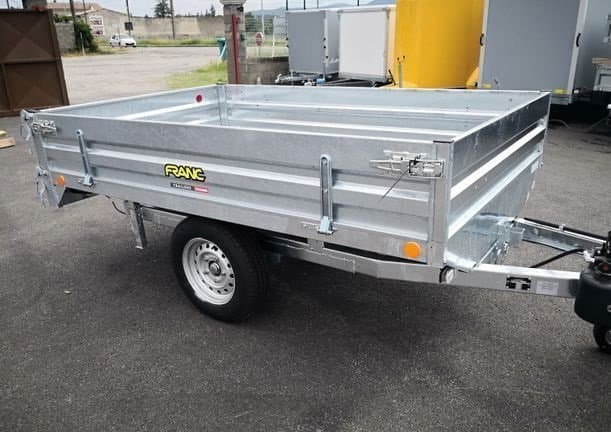
The Franc BRI 130 hydraulic trailer is a transport equipment designed for building professionals, landscapers, farmers and demanding individuals who need a robust and maneuverable tipping bed. It stands out for its simple mechanical design, fully galvanized chassis and manually operated hydraulic lifting system, which allows the contents to be unloaded effortlessly and without depending on an external power source. This model is particularly appreciated for evacuating rubble, soil, sand, compost or green waste, as well as for supplying construction sites with bulk materials. Its payload capacity of 720 kg (gross vehicle weight of 1300 kg minus the empty weight of 580 kg) offers a good compromise between compactness and transport volume, making it suitable for regular use on roads and stabilized paths.
Technically, the trailer is based on a braked axle approved for 1300 kg, equipped with rubber suspension. This type of suspension, without metal springs or hydraulic shock absorbers, is known for its robustness, freedom from routine maintenance and stable behavior under load. Braking is provided by an overrun system with control on the V-drawbar, a device that automatically brakes the trailer when the towing vehicle slows down, thus improving the safety and stability of the combination. The telescopic jockey wheel facilitates maneuvers when stationary and hitching, while the rear stabilizer legs keep the trailer in a safe position when tipping the bed. The lights are protected by recessing, which limits the risk of breakage when moving over cluttered terrain, and the 13-pin plug ensures an electrical connection compliant with recent vehicles.
The bed itself has useful dimensions of 259 cm in length and 159 cm in width, with a floor height of 75 cm. The removable high galvanized steel side panels measure 35 cm in height and can be removed or folded down as needed, allowing bulky objects to be loaded or work in flatbed configuration. The floor is made of 15 mm thick bakelized wood, a material that resists moisture, impacts and common chemicals, while offering a non-slip surface for loads. Under this floor, welded galvanized steel reinforcements ensure the rigidity of the assembly and prevent any deformation under load. The chassis is mechanically welded and hot-dip galvanized, a finish that durably protects the structure against corrosion, including in humid or salty environments. The tipping system is based on a hydraulic cylinder powered by a manual pump, capable of lifting the loaded bed to the dumping position. The lifting power can be adapted according to the chosen configuration: 1200, 1100, 1000, 950 or 750 kg, which allows the effort to be modulated according to the load and the user's preference.
The rear opening is two-way, meaning the rear panel can be opened downward or upward depending on use. This versatility facilitates unloading bulk materials, emptying the bed by tipping or loading long objects. The four lashing hooks integrated into the chassis allow loads to be secured using straps or ropes, in accordance with transport requirements. The trailer is supplied with its original German papers and the original purchase invoice in your name, which simplifies registration procedures in France. It is important to note that, to drive on public roads in France, a trailer of this type must be registered and insured. The gross vehicle weight rating (GVWR) of 1300 kg places it in the light trailer category, towable with a B license under certain conditions regarding the weight of the combination of towing vehicle plus trailer. It is recommended to check compatibility with the towing vehicle, particularly the maximum towing weight indicated on the registration document, as well as the presence of an approved hitch device.
The use of this hydraulic trailer extends to many fields. In construction, it allows the evacuation of rubble, material offcuts, packaging and construction waste. Landscapers use it to transport soil, mulch, stones, sand and green waste. Farmers see it as a practical tool for spreading manure, transporting fodder or small equipment. Individuals appreciate its ability to transport furniture, DIY materials, green waste or rubble during landscaping work. Thanks to its hydraulic tipping, unloading does not require a shovel or additional labor, which reduces physical strain and working time. The bed can also serve as a mobile workstation or temporary storage support on a construction site, once stabilized on the ground.
Maintenance of the trailer is simple but regular. Tire pressure, brake lining wear, hydraulic oil level and hose condition should be checked periodically. The manual pump should be operated smoothly and purged if necessary. Lubrication points (tipping axis, joints, hitch) should be lubricated according to the manufacturer's recommendations. The bakelized wood floor can be cleaned with water and brushed; it is advisable to protect it from sharp or cutting loads that could damage it. The hot-dip galvanizing of the chassis and panels limits the risk of rust, but it is prudent to touch up any scratches with suitable paint. Finally, a visual inspection before each use helps detect anomalies (loose bolts, damaged electrical cables, hydraulic leaks) and ensure safety.
When buying a used or new hydraulic trailer, several points of vigilance deserve attention. The conformity of the documents (certificate of conformity, invoice, manufacturer's plate) must be checked and the serial number must match. The condition of the chassis, welds and galvanizing must be inspected, as well as the operation of the hydraulic cylinder and the absence of leaks. The tires must show even wear and a recent manufacturing date. The braking system must be tested, and the lights checked. Finally, it is recommended to check the actual empty weight and ensure it corresponds to the manufacturer's indications, because a trailer that is too heavy would reduce the payload. The Franc BRI 130 trailer, with its empty weight of 580 kg, offers a comfortable payload for its category.
To go further in daily use, it is useful to dwell on the maintenance actions that truly extend the life of a hydraulic trailer. The hydraulic circuit deserves particular attention: the cylinder and manual pump work under pressure and withstand significant forces with each tipping. It is advisable to regularly check for seepage at the seals, fittings and cylinder body, to check the oil level in the pump reservoir and to top up with hydraulic oil suited to the climatic conditions of use. In cold weather, oil that is too viscous makes lifting slower and more tiring; in hot weather, oil that is too fluid can reduce lifting efficiency. The cylinder rod must remain clean: a soft cloth is enough to remove dust and soil residues, which, if they accumulate, damage the seals and cause leaks. When the trailer is stored for a long time, it is preferable to leave the bed in the lowered position to avoid unnecessarily stressing the cylinder and to protect the rod from the weather.
The hot-dip galvanized chassis requires virtually no paint maintenance, but friction areas, welds and wear points where the zinc layer may be scratched by repeated impacts must be monitored. Regular cleaning with clear water, especially after transporting salty, acidic or humid materials, limits the risk of corrosion. The tipping axes, rear tailgate joints and hitch hook should be greased periodically to avoid blockages and premature wear. Tires should be inflated to the manufacturer's recommended pressure, checked when cold, and replaced as soon as the tread depth approaches the legal minimum or the sidewall shows cracks. Wheel bearings, often neglected, deserve a check for play and greasing according to frequency of use; a worn bearing manifests as a humming noise or lateral play in the wheel, and must be replaced without delay.
The overrun braking system also requires rigorous monitoring. Brake linings wear gradually and should be inspected at least once a year, more often in intensive use. The adjustment of the overrun brake, which determines the travel of the linkage and the braking efficiency, must be checked because poor adjustment causes either too little braking or wheel locking during braking. The control cables and rods must be checked for wear, corrosion or stiff points. Finally, the hitch device and the towing vehicle's ball must be clean and greased, and the safety lock must engage correctly with each hitch.
Regarding the regulations applicable in France, a trailer with a GVWR of 1300 kg falls into the light trailer category. To drive on public roads, it must be registered, insured and equipped with compliant lighting and signaling. A B license allows towing a trailer with a GVWR not exceeding 750 kg, or a trailer over 750 kg if the sum of the GVWRs of the towing vehicle and trailer does not exceed 3500 kg. With a GVWR of 1300 kg, this trailer can be towed with a B license by a vehicle whose GVWR does not exceed 2200 kg, provided that the maximum towing weight authorized by the vehicle manufacturer is sufficient. If the sum exceeds 3500 kg, the B96 training or BE license may be necessary. It is essential to respect the maximum towing weight indicated on the vehicle registration document, as well as the maximum drawbar load, generally between 50 and 75 kg for this type of trailer. Exceeding the GVWR, even slightly, exposes you to penalties and compromises safety, particularly during emergency braking or steep descents.
Loading must be distributed evenly, with a slight preference for the front to maintain a positive load on the drawbar and avoid snaking. Heavy loads should be placed over the axle or slightly forward, and bulky but light loads at the rear. The four lashing hooks allow loads to be secured using straps, and it is recommended to use devices suited to the type of material transported. When transporting powdery materials, a tarpaulin may be necessary to prevent flying debris and comply with traffic regulations. The trailer's license plate must be visible and illuminated, and the warning triangle and safety vest must be present in the towing vehicle. Finally, the maximum authorized speed for a trailer is generally limited to 130 km/h on motorways, but it may be lower depending on the trailer's characteristics and the information on its registration document; it is prudent to drive at a moderate speed, especially when loaded.
To place this trailer in a range, it is useful to compare it with other common configurations. An unbraked trailer with a GVWR of less than 750 kg is lighter, simpler and less expensive to buy and maintain, but it offers lower payload and volume and does not allow heavy materials to be transported in large quantities. A braked 1300 kg trailer like the BRI 130 is an interesting compromise: it allows a payload of 720 kg, sufficient for most common work, while remaining towable by many passenger cars and light utility vehicles. Beyond that, trailers with GVWRs of 1800 kg, 2000 kg or 2500 kg offer greater capacities but often require a BE license, a more powerful towing vehicle and heavier maintenance. The choice therefore depends on the volume and weight of the materials transported, the frequency of use and the available vehicle.
Compared with a non-tipping bed trailer, the hydraulic version provides decisive unloading comfort: instead of shoveling the contents, the user operates the pump and the bed empties by gravity. This saving in time and physical strain justifies the investment for regular users. Compared with a single-axle unsprung trailer, the rubber suspension of the BRI 130 improves roadholding and protects the cargo from vibrations, which is appreciable for transporting fragile equipment or plants. Finally, compared with a trailer with fixed sideboards, the 35 cm removable side panels offer modularity that allows the trailer to be adapted to loads of varying height or to work in flatbed configuration.
In conclusion, the Franc BRI 130 hydraulic trailer is a versatile, robust and functional tool designed to last. Its manually operated tipping bed, removable panels and galvanized chassis make it an effective solution for transporting and unloading bulk materials. It is aimed at a wide audience, from building professionals to DIY enthusiasts, and stands out for its ease of use and limited maintenance. With its well-defined technical characteristics, it meets the requirements of users looking for a reliable trailer for loads up to 1300 kg. However, road safety rules must be respected and a suitable towing vehicle used to fully benefit from its capabilities.