Description
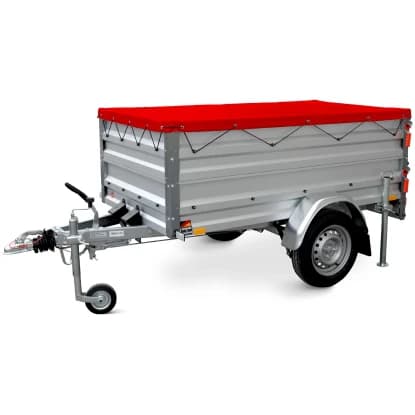
The Variolux 850 braked trailer with side extension is a road transport unit designed for versatile use, both domestic and professional. It stands out for its low-profile structure, overrun braking and load capacity optimised for a compact footprint. This model is supplied new, with all the elements required for its approval and immediate use on public roads.
The chassis of this trailer is made of hot-dip galvanised steel, a finish that ensures durable protection against corrosion. The sides benefit from an aluminium-zinc Galvalume® coating, known for its resistance to weather and external attack. This combination of treatments allows regular outdoor use, including in damp conditions, without rapid deterioration of the structure. The floor is made of waterproof glued plywood, with a non-slip surface coated in phenolic resin. This design provides good grip for loads and limits the risk of slipping during transport.
The usable loading area measures 201 cm long by 108 cm wide, a generous platform for a trailer of this size. The height of the side walls, once the side extension is fitted, reaches 69 cm. This extension, supplied unassembled, adds 36 cm to the original sides. It is fitted using the included assembly instructions and significantly increases the loading volume, up to almost 1.5 m³ depending on the configuration. This extra volume is particularly useful for transporting light, bulky materials such as green waste, cardboard, textiles or bulky but low-density items.
The gross vehicle weight rating (GVWR) of the trailer is 850 kg. The maximum payload, which corresponds to the weight of goods that can be carried, is 641 kg. This difference between GVWR and payload is explained by the trailer's unladen weight, stated at 205 kg. It is essential to respect this limit to guarantee the safety of the convoy and compliance with road regulations. The support load at the hitch is given as 75 kg, a value that must be taken into account when loading so as not to overload the tow ball of the towing vehicle.
The trailer rests on a single axle, fitted with quality rubber springs. This type of suspension, compact and without complex maintenance, absorbs road irregularities and contributes to the stability of the unit. Shock absorbers are fitted as standard, allowing approval for a speed of 100 km/h on motorways, subject to compliance with legal conditions and the characteristics of the towing vehicle. Braking is provided by an overrun system with automatic reverse function. This device brakes the trailer when the towing vehicle decelerates and disengages automatically in reverse, preventing the wheels from locking.
The loading threshold height is 54 cm, a relatively low value that makes loading and unloading easier, including for heavy or bulky objects. This low-profile design lowers the trailer's centre of gravity and improves its roadholding, particularly in bends. The base thickness is 9 mm, reflecting the robustness of the platform. The wheels are fitted with new tyres on 13-inch rims, i.e. a diameter of 33.02 cm. A jockey wheel is supplied, making manoeuvring easier when stationary and when moving the unhitched trailer.
The trailer's total external dimensions are 2.92 m long, 1.49 m wide and 1.26 m high. These measurements include the drawbar and equipment. The unladen weight of 205 kg allows the trailer to be towed by a wide range of vehicles, subject to compliance with the towing capacities approved by the manufacturer. In France, driving a trailer with a GVWR of 750 kg or less does not require a specific licence beyond category B. For a GVWR between 750 kg and 3,500 kg, category B may suffice if the combined GVWR of the towing vehicle and trailer does not exceed 3,500 kg. Otherwise, additional training (category BE) may be required. It is therefore advisable to check compatibility between the towing vehicle and the trailer before purchase.
Standard equipment includes several elements that enhance safety and practicality. A peripheral rail is integrated into the sides, offering numerous lashing points for securing loads. Four lashing hooks are also present on the loading surface. The large multifunction rear lights incorporate a rear fog light and a reversing light, in accordance with European requirements. The electrical connection is made via a 13-pin plug, a widespread standard that ensures compatibility with most recent vehicles. Stema safety latches, recognisable by their flexible red handle, secure the rear panel.
An elastic plastic hitch protector, commonly known as Red-Nose, is fitted as standard. It protects the towing vehicle's bumper from impacts and rubbing during hitching and unhitching. The trailer is also equipped with an anti-theft device, providing additional protection against theft. The flat tarpaulin supplied covers the load, protecting it from rain and preventing light items from blowing away. Props are included to stabilise the trailer when fitting the extension and during stationary loading operations.
The V-shaped drawbar is an additional safety feature: this shape ensures better distribution of forces and greater stability when towing. The additional crossmember in the frame serves as ground support and stabilises the loading surface. The sides are moulded several times, increasing their rigidity and resistance to twisting. The whole is designed to withstand the stresses of regular use, whether for short or long journeys.
This trailer has multiple uses. For private individuals, it is suitable for transporting gardening materials, soil, rubble, furniture, DIY equipment or household appliances. The side extension allows larger volumes of dead leaves, branches or green waste to be carried while keeping the load contained. For professionals, it can be used to transport goods, tools, building materials or spare parts. Its 641 kg payload covers a wide range of needs without requiring a large utility vehicle.
Trailer maintenance is simple but regular. It is advisable to check tyre pressure before each use, check brake lining wear and the correct operation of the overrun system, grease the pivot points (hitch, jockey wheel, hinges) and regularly clean the loading surface to avoid debris build-up. The wooden floor, although treated, may be subject to wear; periodic inspection allows any cracks or weakened areas to be detected. The coated steel sides should be inspected for deep scratches that could expose the metal to corrosion. In the event of damage, a suitable paint touch-up can extend the life of the protection.
When buying a new trailer, several points deserve attention. Check that the GVWR and payload match your actual needs and your towing vehicle's capacities. Ensure the trailer is supplied with all mandatory documents: registration document, CE declaration of conformity (CoC paper) and user manual. These documents are essential to register the trailer and drive legally. Also check the presence of safety equipment: lights, brakes, hitch, props, tarpaulin. A towing test when empty can verify correct operation of the brakes and lighting.
French regulations require that any trailer with a GVWR exceeding 500 kg be registered and have a registration document. The number plate must be fixed to the rear of the trailer and be illuminated. The signal lights must comply with current standards. The driver must ensure the load is correctly secured and that the total weight respects the authorised limits. In the event of exceeding them, penalties may apply. It is also advisable to check the electrical compatibility between the trailer's 13-pin plug and the towing vehicle; an adapter may be necessary if the vehicle has a 7-pin socket.
In summary, the Variolux 850 braked trailer with side extension is a reliable, robust and versatile transport tool. Its manufacture in Germany, its corrosion-treated materials, its overrun braking and its complete equipment make it a solution suited to the needs of private individuals and professionals. With a payload of 641 kg and an extendable loading volume, it meets many situations without compromising on safety. Before any use, it is advisable to familiarise yourself with its operation, follow the maintenance instructions and check that the convoy complies with road regulations.
To go further with maintenance, it is useful to distinguish checks to be carried out before each departure, those to be carried out monthly and those forming part of an annual service. Before each journey, a quick but methodical check is essential: tyre pressure and condition, including the spare wheel if you carry one, operation of position, brake, indicator and fog lights, locking of the hitch on the ball, correct connection of the 13-pin plug, presence and tension of lashing straps, and correct operation of the raised jockey wheel. This few-minute ritual prevents the majority of minor incidents that occur en route.
Every month, or more frequently with intensive use, it is advisable to inspect the overrun braking system. This includes checking the play in the linkage, the condition of the control cables or rods, lining wear and parking brake adjustment. A poorly adjusted brake can cause jerking, premature tyre wear and longer braking distances. Greasing of the hitch pivot points, the jockey wheel axle and the side hinges should be carried out with a suitable, water-resistant grease. Wheel bearings, although compact and undemanding, should be monitored: an abnormal noise, excessive play or hub overheating after a journey are warning signs not to be ignored.
Once a year, a more complete service is advisable. It may include removing the wheels to check the condition of the bearings and linings, checking tyre wear (including their age, as an unused tyre ages), examining the wooden floor for rot or delamination, and inspecting the galvanised chassis for any areas of white rust or corrosion. Replacing wear parts (linings, cables, rubber bushes) is generally inexpensive and keeps the trailer in good working order for many years. It is also wise to check the tightness of the bolts securing the sides, axle and hitch, as vibrations can gradually loosen them.
Storing the trailer between uses also deserves some precautions. Ideally, it should be stored in a dry, sheltered place, or failing that under a breathable cover to avoid condensation. Leaving it on earth or grass encourages moisture around the chassis and wheels; a hard, drained surface is preferable. If the trailer remains immobilised for a long time, it is advisable to raise the axle slightly to relieve the tyres and avoid a permanent flat spot. Regular cleaning, especially after transporting dirty or corrosive materials (soil, rubble, salt), extends the life of the coatings.
From a regulatory point of view, driving with a trailer in France is subject to several specific rules. In addition to mandatory registration above 500 kg GVWR, the trailer must be insured. In general, the towing vehicle's third-party liability cover includes the trailer, but it is prudent to check with your insurer, as some companies require an extension of cover or a specific policy. The driver must also ensure that the load does not extend more than 3 metres beyond the rear of the trailer, and that the total weight of the convoy remains within the authorised limits. If the payload is exceeded, the insurer may refuse to compensate a claim and a fine may be imposed.
The maximum permitted speed for a towing vehicle plus trailer combination depends on several factors. In the absence of specific 100 km/h approval, speed is limited to 80 km/h on motorways and 90 km/h on dual carriageways, in accordance with current regulations. Obtaining 100 km/h approval requires the trailer to be fitted with shock absorbers, which is the case here, and the towing vehicle to meet certain weight and equipment conditions (ABS in particular). A certificate issued by the manufacturer or importer is then required. It is important to note that this approval is only valid for the specific vehicle-trailer combination stated on the document.
Transporting specific loads sometimes requires additional precautions. For bulk materials (sand, gravel, soil), it is advisable to distribute the load evenly and not to exceed the height of the sides, even with the extension, so as not to alter the centre of gravity. Long objects (planks, tubes, ladders) must be securely lashed and marked at the rear with a reflective device if their overhang exceeds 1 metre. Liquid loads must be contained in closed, secured containers, as any movement can unbalance the trailer. Finally, transporting live animals, dangerous goods or specific waste may be subject to particular regulations that should be checked beforehand.
In the professional field, the Variolux 850 fits into many sectors. Builders can use it to transport bags of cement, bricks, tools or small hardware. Landscapers load plants, compost, mulch or small equipment. Electricians and plumbers store their boxes, tubes and tools. Cleaning businesses can place bins, pressure washers or consumables. For farmers or horse owners, it is used to transport hay, straw, pellets or maintenance equipment. In retail, it facilitates local deliveries or shuttles between a warehouse and a point of sale. Finally, for private individuals, it remains a valuable tool for moving house, renovation work, gardening or leisure (transporting bikes, camping equipment, etc.).
Compared with other trailers in the same family, the Variolux 850 sits in an intermediate segment. An unbraked trailer with a 750 kg GVWR is lighter and cheaper, but its payload is often lower and its road behaviour less stable when fully loaded. A braked trailer of 1,300 kg or 1,500 kg offers greater capacity, but it is heavier, bulkier and requires a more powerful towing vehicle, as well as, in some cases, a category BE licence. The Variolux 850 therefore represents an interesting compromise: enough payload for most domestic and light trade uses, a reasonable weight to be towed by a saloon or small SUV, and dimensions that remain manageable in town and on minor roads. The side extension adds valuable versatility without significantly increasing the unladen weight, preserving the payload.
Compared with twin-axle models, the single-axle trailer is lighter, easier to manoeuvre by hand and cheaper to maintain (fewer tyres, fewer brakes). In return, it is slightly less stable if the load is poorly distributed and its load capacity is limited. For regular use with loads close to the maximum, a twin-axle trailer may be preferable, but it requires a heavier towing vehicle and a suitable licence. The choice therefore depends on the type of loads, frequency of use and the characteristics of the towing vehicle.
Finally, it is worth remembering that buying a new trailer provides a manufacturer's warranty, the exact terms of which are set out in the documents supplied on delivery. This warranty generally covers manufacturing defects for a defined period, provided that maintenance is carried out in accordance with the recommendations and that the trailer has not been overloaded or used abusively. Keeping maintenance invoices and proof of purchase is therefore recommended to assert your rights if needed. With consistent maintenance and reasonable use, the Variolux 850 can accompany its owner for many years, whether for occasional jobs or regular professional activity.