Description
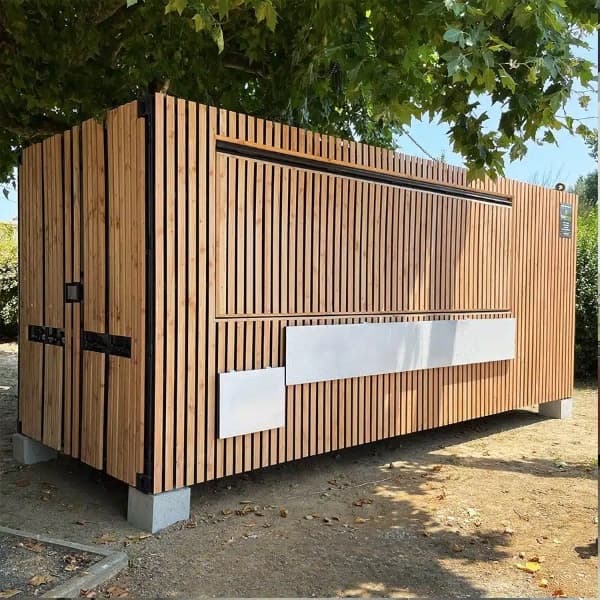
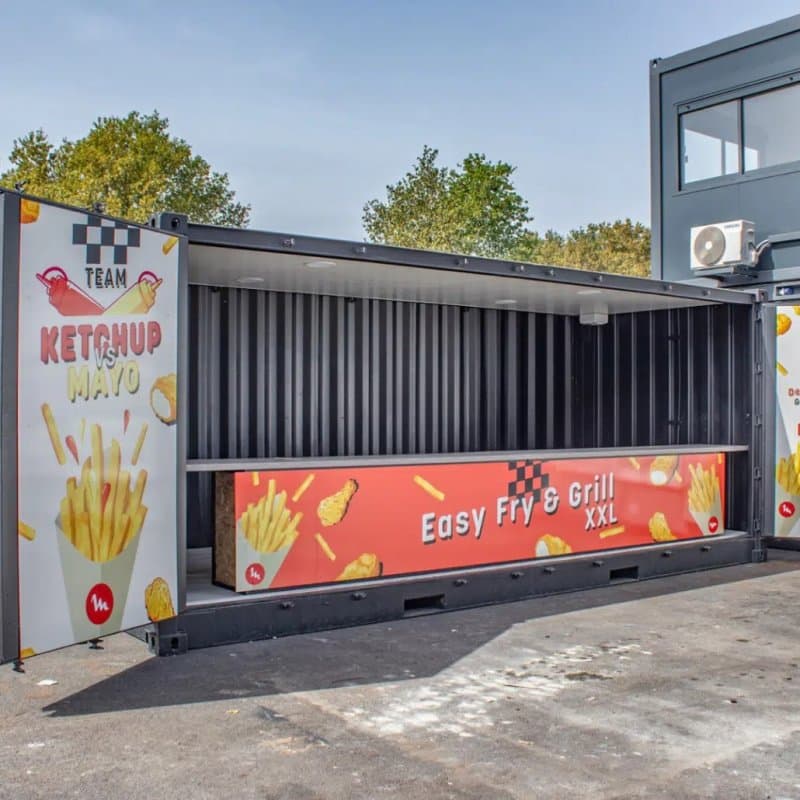
The snack bar container is a mobile and functional solution for selling food and drinks at events, fairs, festivals or public receptions. It is offered for sale or rent, and comes as a ready-to-use unit: simply connect it to the power grid to start using it. This fitted container is aimed at fast-food professionals, event organizers, local authorities or associations looking for a temporary or permanent sales point, without major works. It can also serve as a guard post or ticket office depending on needs.
This container is based on a standard shipping container, modified to meet the requirements of commercial use. The structure is made of Corten steel, a low-alloy steel that offers good resistance to atmospheric corrosion, commonly used in the manufacture of shipping containers. The original walls, roof and floor are retained or adapted, and interior and exterior fittings are added. The original 28 mm marine plywood floor is here replaced or covered with a non-slip checkered aluminium floor, with a floor drain to facilitate cleaning and liquid evacuation. This covering is particularly suitable for food preparation or service areas, as it resists moisture and cleaning products.
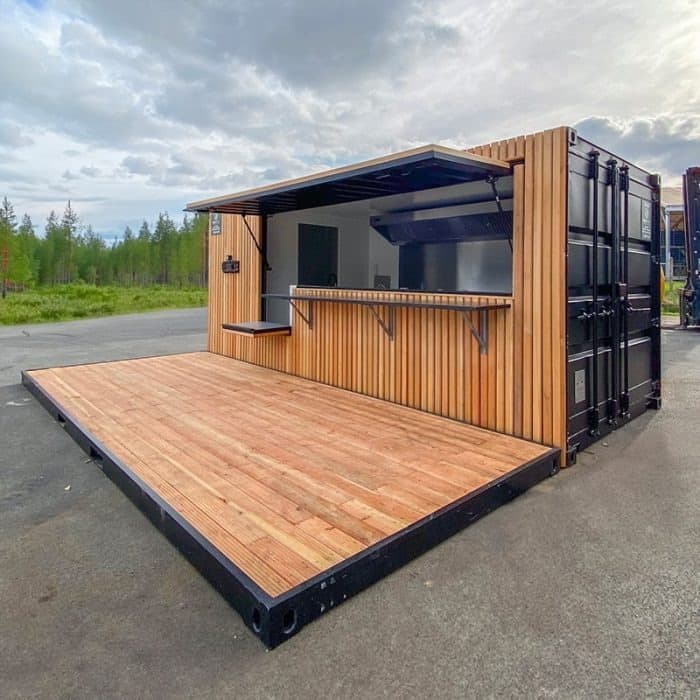
The exterior layout includes a 4-metre-long awning, deployed by gas struts. This awning creates a covered area in front of the counter, protecting customers from sun or rain, and contributes to the sales point's appeal. Access inside is via an access door and a double door, which facilitates staff movement and service. The counter is designed with an accessible (PRM) access, to comply with public accessibility standards. This counter can be fitted with refrigerated display cases or display stands, depending on the intended use, but these items are not included by default.
Inside, the ceiling is insulated and fitted with six LED spotlights, providing sufficient lighting for preparation and service. Ceiling insulation contributes to thermal comfort and can reduce condensation. The electrical pack includes a connection plug, a distribution board and four 220V sockets, distributed throughout the space. This pack can power the usual equipment of a snack bar: coffee machine, refrigerator, refrigerated display case, lighting, cash register, etc. It is important to check the total available power and ensure that the site's electrical installation can support the load. In France, all electrical installations must comply with NF C 15-100 for premises receiving the public, and it is recommended to use a qualified electrician for the final connection.
The snack bar container can be used as a fixed food truck, i.e. without moving, or as a mobile unit if the container is loaded onto a truck or a container trailer. In the latter case, regulations on exceptional transport must be respected if dimensions or weight exceed authorized limits. A standard 20-foot shipping container measures approximately 6.06 m long, 2.44 m wide and 2.59 m high, with an empty weight of around 2.2 to 2.4 tonnes. The snack bar container can be based on a 20-foot or 10-foot unit, depending on the desired sales area. Exact dimensions are not provided in the product sheet, but this information can be requested when ordering. The total loaded weight depends on the equipment installed and storage; it must not exceed the maximum load allowed by the container, generally indicated on the CSC plate (Convention for Safe Containers).
On-site installation requires a flat, stabilized surface capable of supporting the weight of the container and its equipment. A compacted gravel bed or concrete slab is recommended to prevent subsidence. The container should be placed on blocks or crossbeams to isolate the floor from the ground and allow ventilation. If the container is intended to remain permanently, it is advisable to anchor the structure to withstand strong winds. For temporary installation, shimming may suffice, but stability must be checked before each use.
Maintenance of the snack bar container is relatively simple. Surfaces should be cleaned regularly, especially the worktop and aluminium floor, with products suitable for food use. The awning's gas struts must be checked periodically to ensure they work properly and do not leak. Door and window seals must be checked to prevent water ingress. If rust appears on the Corten steel, local treatment with anti-rust paint may suffice, but it is important to treat any corrosion area quickly to prevent it spreading. The roof should be inspected regularly to remove leaves and debris that could retain moisture.
When buying a snack bar container, several points require attention. First, check the general condition of the container: perforating rust, deformation, watertightness. A used container may show signs of corrosion, especially on the roof and lower walls. Second, it is essential to check the compliance of the electrical installation: the electrical pack must meet standards, with a distribution board, residual current devices and correct earthing. For use receiving the public, regulations require periodic checks of electrical installations. Finally, ensure the container has the necessary certifications, including CSC marking if it is to be transported, and ISO 668 conformity certificate for dimensions and loads.
French regulations govern the installation and operation of a snack bar. For a fast-food activity, it is necessary to comply with food hygiene rules (EC Regulation No. 852/2004), have a drinking water point for hand and food washing, and a wastewater disposal system. The snack bar container can be fitted with a sink and water heater, but these are not mentioned in the product sheet; they should be provided as an extra. In addition, the installation must be declared to the town hall or prefecture depending on the nature of the event and the duration of operation. For regular commercial activity, a public domain occupation permit may be required.
The snack bar container can be customized as needed: colour, signage, interior layout, addition of refrigerated display cases, air conditioning, etc. These options are not included by default and must be requested when ordering. An economy version such as a ticket office bungalow is also available, as well as used models resold at the end of the season. These alternatives allow the solution to be adapted to different budgets and uses.
In summary, the snack bar container is a turnkey solution for mobile or fixed vending. It combines the robustness of a shipping container with functional, ready-to-use fittings. Its quick installation, accessible counter and electrical equipment make it a versatile tool for event and catering professionals. However, regulatory and technical aspects should be checked before any operation, and ensure the container meets applicable safety and hygiene requirements.
To go further in the use and management of this container, it is useful to examine in more detail aspects related to routine maintenance, transport regulations, sector-specific use cases, as well as alternatives in container sizes and types. These elements allow an informed choice and optimize the operation of the unit.
Preventive maintenance of the snack bar container should be planned regularly. Once a month, it is recommended to inspect the entire structure: roof, walls, floor, doors and awning. The roof is the part most exposed to weather and debris accumulation; annual cleaning prevents water stagnation and corrosion. Gutters and water outlets must be kept clear. Exterior Corten steel walls can be washed with clean water and neutral soap; a pressure washer can be used but should remain at low pressure to avoid damaging seals and paint. If paint flakes appear, it is advisable to treat them with anti-rust paint suitable for metal surfaces. Inside, the checkered aluminium floor should be cleaned after each service, especially in food preparation areas. A food-grade degreaser followed by rinsing with clean water is sufficient. The floor drain must be checked and cleaned to avoid blockages. LED spotlights and the electrical panel must be visually checked; any sign of overheating, bare cable or circuit breaker tripping repeatedly should lead to intervention by a professional. The awning's gas struts must be tested regularly: they should hold the awning in position without excessive effort. If the awning becomes difficult to operate or no longer holds, replacement should be considered. Finally, the door and double door seals must be checked and replaced if necessary to prevent air and water ingress.
Transport regulations for containers in France deserve particular attention if the snack bar is to be moved. A standard 20-foot shipping container can be transported on a container truck without special authorization if the total loaded weight does not exceed road code limits (40 tonnes for a road train). However, if the container is fitted out and loaded with equipment, its weight may increase and require precautions. Exceptional transport is required when dimensions or weight exceed regulatory thresholds (width over 2.55 m, length over 16.50 m, weight over 48 tonnes for a category 1 exceptional convoy). For a 20-foot container, the width is 2.44 m, which remains within limits. The total height of truck and container can reach about 4 m, which is acceptable on most roads, but bridges and tunnels along the route must be checked. For a 40-foot container, the length increases to 12.19 m, which may require authorization depending on the route. Transport must be carried out by a professional carrier with the necessary authorizations and a suitable vehicle. It is also important to check that the container is properly secured on the chassis or trailer, with twist-locks in good condition. The CSC marking must be valid; it certifies that the container complies with safety rules for international transport. If the container is used only on a private site, without public road circulation, these constraints are reduced, but good handling practices are still recommended.
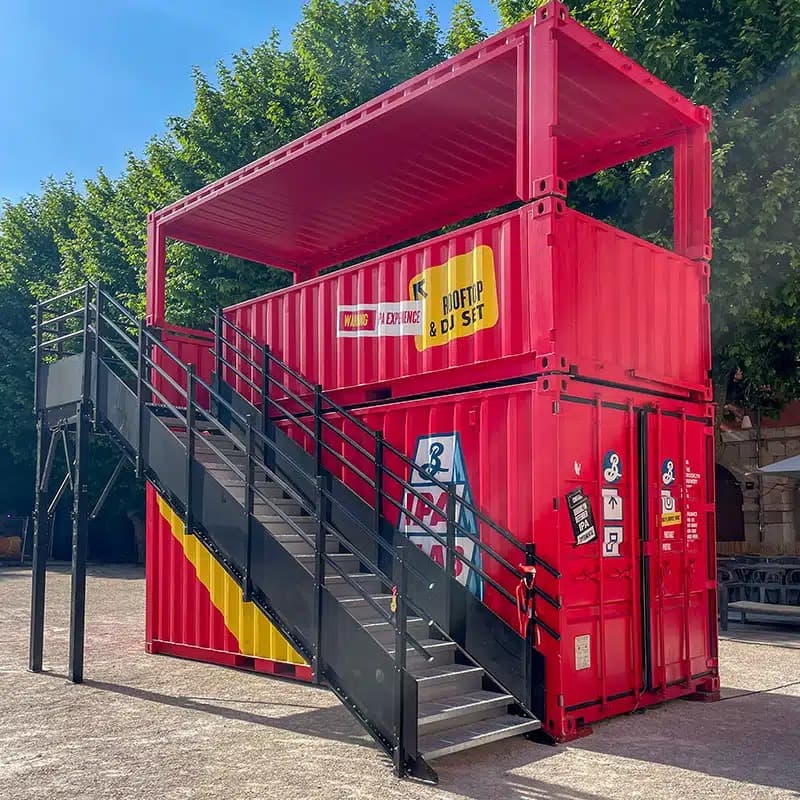
Sector-specific use cases for the snack bar container are varied. In the events sector, it is used for festivals, trade shows, Christmas markets, sports competitions, concerts and gatherings. Its mobility allows it to be positioned as close as possible to the public, and its awning provides a covered reception area. Organizers appreciate the speed of installation: a few hours are enough to put it into service, compared with several days for traditional construction. In fast food, it can serve as a fixed sales point on a square, car park or private land. Container food trucks have the advantage of being more spacious and better insulated than a fitted truck, and they can be customized with signage and colours. For local authorities, it can become a municipal snack bar, a tourist information point or a ticket office for a cultural site. In the security sector, it can be transformed into a guard post for a construction site, car park or industrial site, with a counter and panoramic view. Finally, for associations, it offers an economical solution for running a snack bar at fairs or tournaments.
Compared with other container sizes and types, the snack bar stands out for its specific fittings. A standard 20-foot dry container offers a usable area of about 13.8 m² (6.06 m x 2.44 m) and a volume of 33 m³. A 40-foot container doubles this area to about 28.3 m² and 67 m³, allowing a larger kitchen, a dining area or additional storage space. A high cube (HC) container offers an interior height about 30 cm greater, improving comfort and allowing equipment to be installed at height. A reefer container is fitted with a refrigeration unit and can be used to store perishable goods, but it is heavier and requires a more powerful power supply. An open top or flat rack container has no roof or side walls, making it unsuitable for a closed snack bar. The snack bar container can be based on a 10, 20 or 40-foot dry container, with or without high cube, depending on the sales area and budget. The choice depends on the space available on site, the number of customers to serve simultaneously and the equipment to be installed. A 10-foot container (about 3 m long) is suitable for a small snack bar or ticket office, while a 20-foot is versatile for most uses. A 40-foot allows a complete kitchen and storage space, but it is more difficult to move and requires a larger surface.
In terms of customization, it is possible to add windows, roller shutters, air conditioning, heating, a sink, a water heater, refrigerated display cases, a larger awning, outdoor lighting, an illuminated sign, etc. These options must be ordered separately and can increase the total cost. It is advisable to define the specifications precisely before ordering to avoid costly modifications after manufacture. A layout plan can be provided by the manufacturer or fitter, and it is recommended to validate it before production starts.
The snack bar container can be delivered and installed by the supplier or by a specialized carrier. It is important to check access conditions on site: road width, bridge height, overhead cables, ground stability. A crane or crane truck may be necessary to unload the container. Delivery cost depends on distance and handling equipment. It is recommended to allow sufficient delivery time before the event, and to test all equipment (electricity, awning, doors) upon receipt.
Finally, for professional use, it is advisable to take out suitable insurance covering the container, its contents and liability related to operation. A multi-risk business insurance can include protection against theft, fire, water damage and damage to third parties. It is also recommended to keep a maintenance and equipment check log, especially electrical, to prove compliance in the event of an inspection.
With these additions, the snack bar container appears as a complete, modular and durable solution for many commercial and event uses. However, its purchase or rental should be accompanied by consideration of real needs, regulatory constraints and desired options, to ensure smooth and compliant operation.