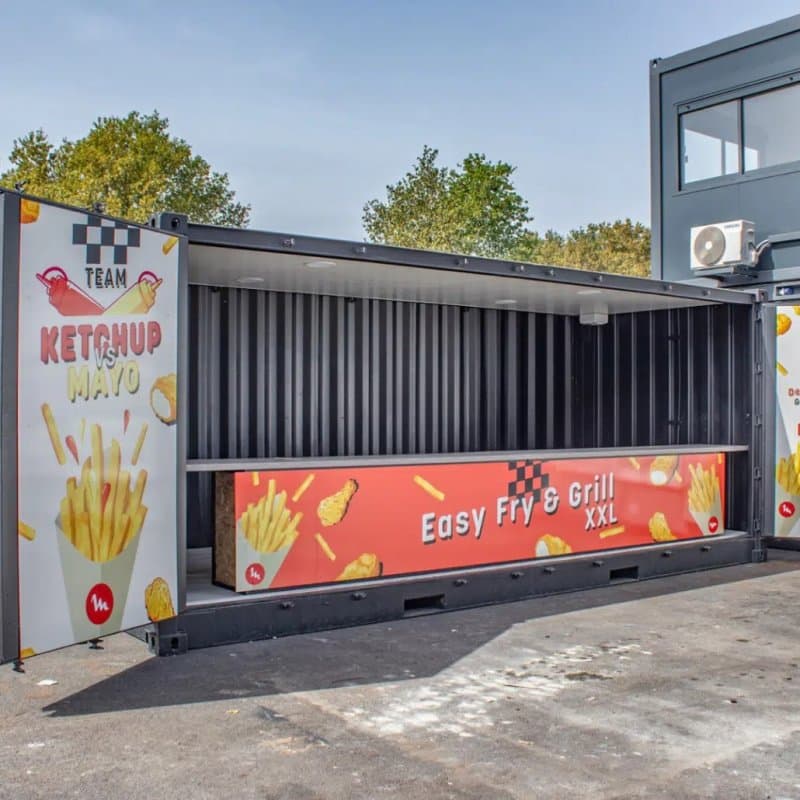
Description
The mobile ticketing container is a practical solution for managing guest services at a wide range of events: festivals, sports competitions, trade fairs, markets, concerts and cultural events. Built from a converted standard shipping container, it provides a functional, transportable workspace that is immediately operational. This product is aimed at organisers, local authorities, event service providers and businesses looking for a durable, reusable reception structure.
The ticketing container is based on an ISO shipping container, typically 20 ft (6.05 m) or 40 ft (12.19 m). These standard dimensions are internationally recognised and make transport, lifting and on-site installation easier. The structure is made of Corten steel, a low-alloy steel that resists atmospheric corrosion through the formation of a protective surface layer. This is particularly useful for prolonged outdoor use exposed to the weather. The floor is made of 28 mm marine plywood, a dense, moisture-resistant material suited to intensive use and repeated foot traffic. The double-leaf rear doors, fitted with container locks, ensure secure closure and a wide opening for loading or interior fit-out.
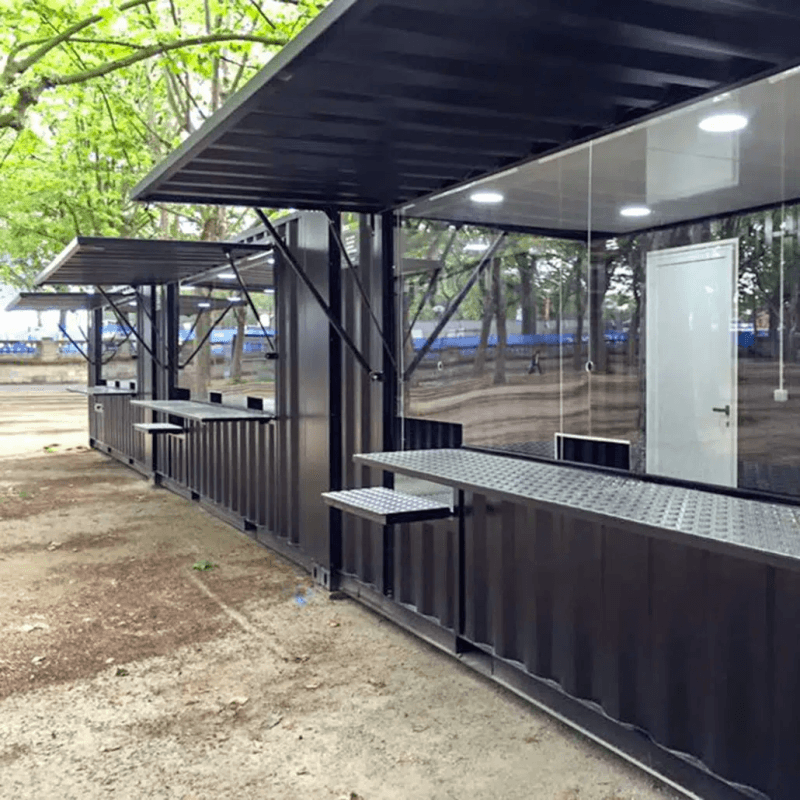
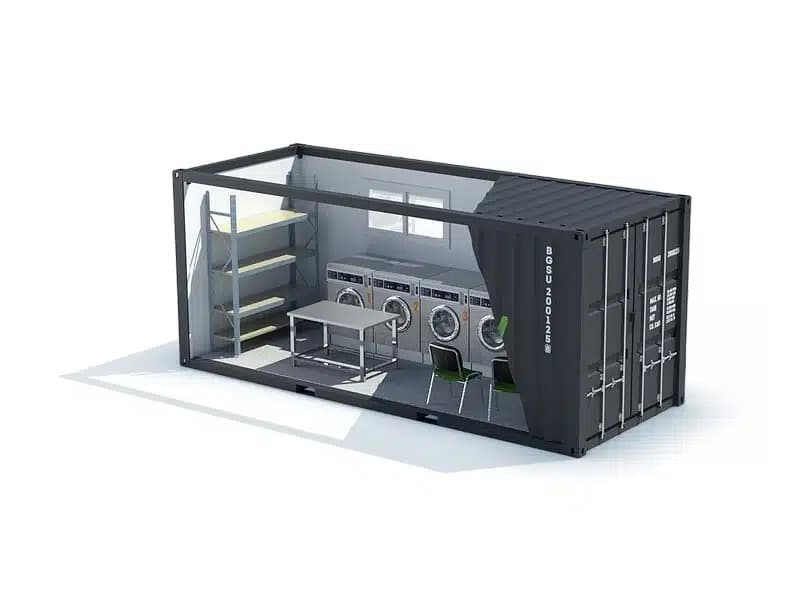
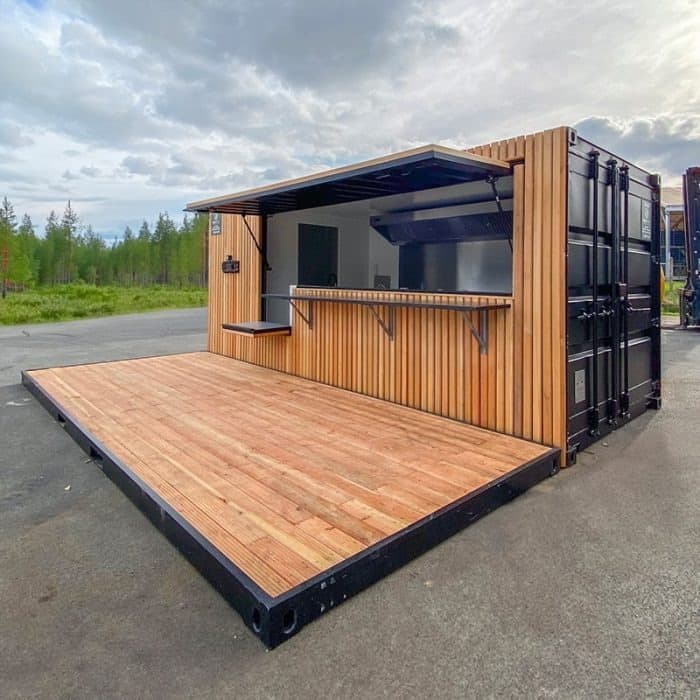
The interior fit-out of a ticketing container can vary according to needs. In its basic version, the container is an empty volume ready to be equipped. Common configurations include a sales or reception counter, storage shelves, interior lighting, a power socket, thermal and acoustic insulation, air conditioning or heating depending on the season, and exterior signage. These fit-outs are not necessarily included in the base product and must be specified with the supplier. The container can also be fitted with glazing or service windows to facilitate communication with the public and secure transactions.
Mobility is one of the main advantages of this container. It can be transported by container truck, train or ship, and moved on site using a forklift, reach stacker or crane. Once placed on stabilised ground, it requires no heavy foundations, which reduces installation costs and lead times. For event use, the container can be set up within a few hours and removed at the end of the event. This flexibility allows the same structure to be reused across multiple sites and at different times of the year.
The versatility of the ticketing container makes it suitable for many uses. Beyond ticketing, it can serve as an information point, pop-up shop, fast-food stand, cloakroom, checkpoint or site office. In the events sector, it is often used for ticket sales, badge distribution, guest reception or visitor flow management. In the commercial sector, it can become a seasonal point of sale in a car park, market square or tourist site. For local authorities, it can serve as a temporary reception office, technical room or first-aid post.
Durability is an important criterion for this type of structure. Corten steel, used in the manufacture of shipping containers, is designed to withstand the marine environment and harsh weather conditions. This does not mean it is immune to corrosion, but it offers better resistance than ordinary steel. To extend the container's lifespan, it is advisable to regularly check the paintwork, touch up scratches and clean surfaces to prevent the build-up of salt, sand or pollutants. Door seals should also be checked and replaced if necessary to maintain water and air tightness.
Routine maintenance of a ticketing container is relatively simple. It involves inspecting the structure (floor, walls, roof, doors) for signs of rust, cracks or deformation. The marine plywood floor must be kept clean and dry; if worn, it can be replaced with a panel of the same type. Hinges and locks should be lubricated periodically to ensure proper operation. If the container is fitted with electrical equipment, an annual check by a professional is recommended to ensure compliance and safety of the installations.
Buying a ticketing container requires considering several points. First, check the general condition of the container: is it a new (one-trip) container or a reconditioned used container? A new container offers better water tightness and a longer lifespan, while a used container may be cheaper but show signs of wear. Next, ensure the dimensions and weight match the transport and lifting constraints at the site of use. A 20 ft container weighs around 2.2 to 2.4 tonnes empty, and a 40 ft container around 3.7 to 4.2 tonnes empty, depending on the model. These weights must be compatible with the available lifting equipment.
French regulations govern the transport and installation of containers. Road transport of containers is subject to vehicle weight and dimension rules, as well as the permits required for abnormal loads if dimensions exceed regulatory limits. Installation on a site must comply with local planning rules: in some cases, a prior declaration or a building permit may be required, particularly if the container is fixed to the ground or used permanently. It is advisable to check with the town hall or the relevant planning department before any installation. In addition, if the container is intended to receive the public, it must comply with current fire safety, accessibility and hygiene standards.
The interior fit-out of a ticketing container can be carried out by the supplier or by a fit-out professional. Common works include insulation of walls and ceiling, floor covering, electrical installation, plumbing (if required), air conditioning or heating, and joinery (counter, shelves, display cases). For event use, it is often useful to provide sufficient lighting, power sockets for IT equipment and an internet connection. Exterior signage can be customised with the event name, organisation logo or practical information.
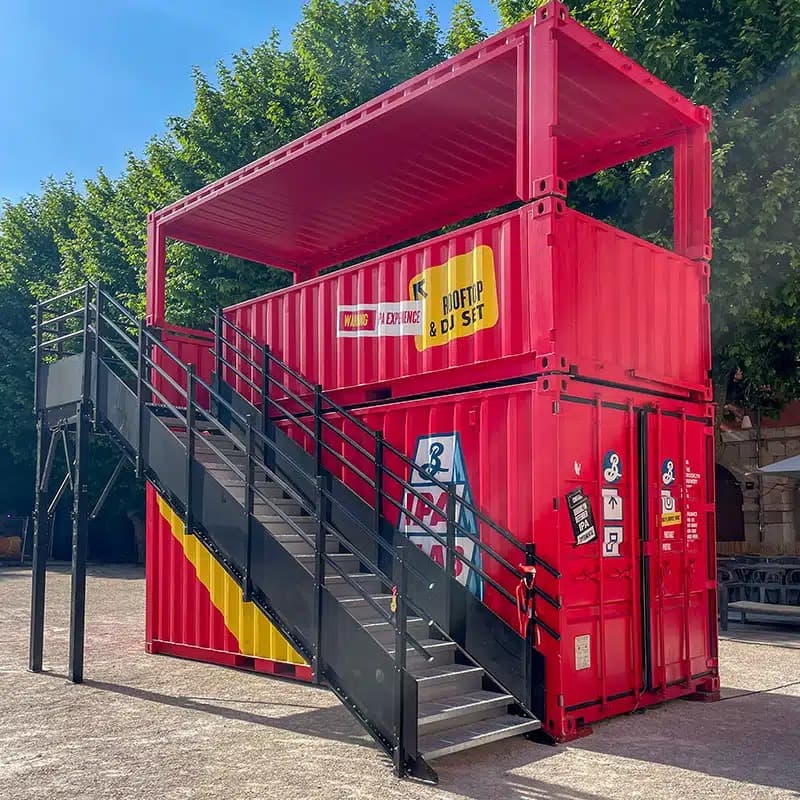
The ticketing container can be used alone or combined with other containers to create a larger complex. For example, several containers can be placed side by side to form a reception village, catering area or exhibition zone. Containers can also be stacked on two levels, provided the structural strength is checked and safety rules are followed. This modularity allows the configuration to be adapted to the event size and available space.
In terms of cost, the price of a ticketing container depends on several factors: size (20 or 40 ft), condition (new or used), level of fit-out (basic or fully equipped), and options (insulation, air conditioning, glazing, etc.). The price indicated for this product is EUR 5,000.00, which generally corresponds to a basic container, probably used, without a full interior fit-out. It is advisable to request a detailed quote to know the total cost according to the desired options.
Renting ticketing containers is also an attractive option for one-off events. It provides a structure for a set period without long-term investment. Rental conditions (duration, transport, installation, insurance) must be specified in the contract. D.S. Globe Conteneur, based in Marseille, offers sales and rental solutions for shipping containers. It is recommended to contact the company to find out about availability, lead times and delivery arrangements.
To choose the right container for your project, it is useful to define your needs precisely: number of people to accommodate, duration of use, location, access constraints, budget, desired options. A 20 ft container offers a floor area of around 14 m², while a 40 ft container offers around 28 m². These areas may be sufficient for a ticketing point, but for a larger reception or sales space, a 40 ft container may be more comfortable. The standard interior height is around 2.39 m for a dry container and 2.69 m for a high cube, which can influence comfort and fit-out.
Maintaining an outdoor ticketing container requires particular attention to roof water tightness. Shipping containers are designed to withstand rain and sea spray, but regular maintenance helps prevent leaks in the long term. It is advisable to check the condition of welds, seals and painted surfaces at least once a year. If water stagnates on the roof, an inspection is necessary: this may indicate deformation or debris preventing drainage. Cleaning the roof and any gutters is one of the simple steps that extend the structure's lifespan. For containers fitted with glazing or service windows, check seals and opening systems (handles, locks) to ensure proper operation and transaction security.
Regulations on container transport in France deserve detail. A 20 ft ISO container has an overall length of around 6.06 m, a width of 2.44 m and a height of 2.59 m. A 40 ft container measures around 12.19 m long, with the same standard width and height. These dimensions are compatible with standard container trucks, but their transport is subject to Highway Code rules on vehicle weights and dimensions. The authorised gross train weight (GTW) and authorised gross vehicle weight (GVW) must be respected. For abnormal loads, prior permits are required from prefectures and road authorities. Transporting an empty 20 ft container generally remains within authorised limits, but transporting a 40 ft or loaded container may require specific procedures. It is therefore essential to check local constraints and use an authorised carrier.
In terms of installation, a ticketing container is considered a mobile or temporary construction in many cases. However, regulations vary depending on the municipality and the duration of installation. A prior works declaration may be required for installations of more than three months, and a building permit may be required if the container is fixed to the ground, permanently connected to utilities or alters the exterior appearance of a building. It is therefore prudent to consult the local planning department before any installation. In addition, if the container receives the public, it must comply with fire safety rules (exits, extinguishers, signage), accessibility (ramps, door width) and hygiene (ventilation, sanitary facilities if necessary). These requirements may vary depending on the type of event and capacity.
Sector-specific use cases for the ticketing container are numerous. In the cultural sector, it can serve as a box office and reception for a festival, open-air theatre or exhibition. In sports, it is used for ticket sales, entry control or accreditation management at competitions. In tourism, it can become an information point or souvenir shop at a natural site or car park. In retail, it allows creating a pop-up point of sale for sales, Christmas markets or fairs. In construction, it can serve as a site office, security post or tool storage room. Finally, for local authorities, it can be used as a temporary reception office, first-aid post or technical room during works or local events.
Comparing container sizes and types helps make the right choice. The 20 ft container is more compact and easier to transport and install on tight sites. It is suitable for small events, simple ticketing points or temporary uses. The 40 ft container offers twice the floor area, allowing several spaces (reception, sales, storage) or a larger public. It is suitable for large events, festivals or major points of sale. The high cube container, with an interior height around 30 cm greater, provides additional comfort and makes it easier to install suspended ceilings, air conditioning or lighting. The standard dry container is the most common and most economical. The reefer container, fitted with a refrigeration unit, is used for transporting perishable goods, but it can also be converted into an air-conditioned room, although its cost and maintenance are higher. The open top container, without a rigid roof, is useful for loading bulky items but less suitable for office use. The flat rack, without side walls, is not suitable for an enclosed fit-out. Finally, the foldable container can be interesting for storage or empty transport, but it is less common for event use.
The choice between buying and renting depends on frequency of use. For one-off use, renting is often more advantageous: it avoids tying up capital, storage and long-term maintenance. For regular or permanent use, buying becomes more cost-effective over time. Transport, installation and fit-out costs should also be taken into account, as they can represent a significant share of the total budget. A reconditioned used container can be an economical alternative, provided its condition is checked and it meets safety and water tightness requirements.
In conclusion, the mobile ticketing container is a robust, flexible and reusable solution for guest services at events. Its Corten steel construction, marine plywood floor and secure doors make it a durable and functional structure. Available in standard dimensions, it can be fitted out as needed and installed quickly on most sites. Before buying, it is important to check the container's condition, ensure regulatory compliance and plan the logistics. D.S. Globe Conteneur, in Marseille, can support you in choosing and implementing your project.