Description
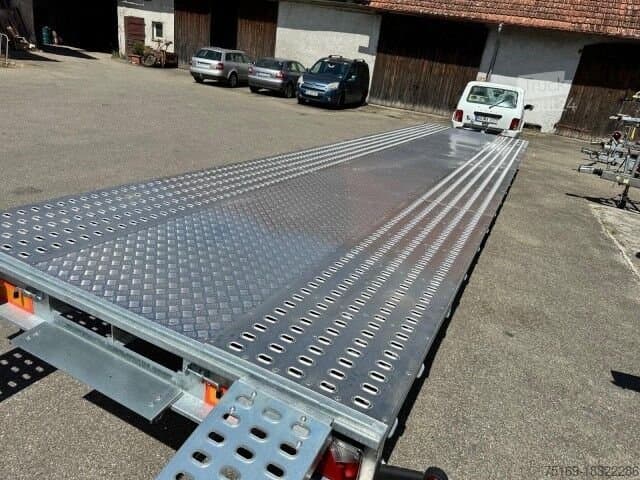
The Niewiadow BR3 14A 35A35V car transporter trailer is specialised transport equipment designed to move motor vehicles over long distances. With its three axles and 3,500 kg GVWR, it is aimed at automotive logistics professionals, dealerships, rental companies, racing stables and demanding private individuals who need to transport a car under optimum safety conditions. This trailer stands out for its platform measuring 9,000 mm long by 2,100 mm wide, a size that allows most saloons, estates, compact SUVs and sports vehicles to be loaded, while leaving room for strapping and securing. The aluminium floor closed at the centre provides a stable, corrosion-resistant running surface, while the 2.5 m steel access ramps, stowed under the platform, make loading and unloading easy without additional equipment. The structure is hot-dip galvanised, a protection that extends the service life of the chassis against bad weather and salt spray, common on coastal roads and in winter. The trailer is braked and equipped with an overrun reverse mechanism, rubber suspension axles and independent suspension, all of which contribute to the stability of the combination, even at full load. The loading height of 690 mm and the working width of 2,100 mm match professional car transporter standards, which simplifies use with lowered vehicles or classic cars. The kerb weight of 1,100 kg leaves a payload of 2,400 kg, sufficient for most passenger cars, including electric models whose weight can exceed 1,800 kg. The 195/55 R13C tyres are sized to support the load and offer good roadholding. The trailer is supplied with a spare wheel, a jockey wheel, marker lights and 100 km/h approval, which allows driving at that speed on French motorways when conditions permit. The registration document and COC papers are included in the price, which simplifies registration procedures. On request, a transit plate can be provided free of charge. This model is particularly suited to transporting vehicles between a garage and a circuit, between a point of sale and a home, or for breakdown recovery. Its robust design and standard equipment make it a reliable tool for regular use. However, the compatibility of the vehicle to be transported with the platform dimensions and the gross vehicle weight rating should be checked. Compliance with loading and securing rules is essential for safety. In France, a trailer of this GVWR must be hitched to a vehicle whose gross vehicle weight rating (GVWR) and gross combination weight rating (GCWR) are compatible. A category B licence is sufficient if the trailer's GVWR is 750 kg or less, or if the sum of the GVWRs (towing vehicle + trailer) does not exceed 3,500 kg. With a GVWR of 3,500 kg for the trailer alone, a BE licence is mandatory, unless the towing vehicle has a GVWR of 3,500 kg or less and the sum of the GVWRs does not exceed 3,500 kg, which is impossible here. A BE licence is therefore required to tow this trailer with a light vehicle. It is also necessary to comply with the speed limits specific to trailers: 130 km/h on motorways if the trailer's GVWR is 3,500 kg or less and if the towing vehicle is fitted with an approved coupling device, but 110 km/h on roads with regulated access, and 80 km/h on other roads. The 100 km/h approval mentioned is a German specific feature (Tempo-100), which does not apply directly in France but confirms the trailer's stability at that speed. In France, the maximum authorised speed for trailers over 750 kg is 130 km/h on motorways, 110 km/h on roads with regulated access and 80 km/h on other roads. It is imperative to check road signs and comply with the Highway Code. Maintaining the Niewiadow BR3 14A 35A35V car transporter trailer is simple but regular. Tyre pressure should be checked before each use, and tread wear and the absence of cracks on the sidewalls should be verified. Rubber suspension axles require no particular maintenance, but it is advisable to check the tightness of the wheel bolts and the condition of the brake linings. The braking system should be checked by a professional at least once a year, especially in the case of intensive use. Hot-dip galvanising protects the structure, but regular cleaning, particularly after exposure to salt or mud, helps preserve its appearance and longevity. The access ramps should be inspected before each use to detect any deformation or corrosion. The aluminium floor closed at the centre should be cleaned to prevent the accumulation of gravel that could scratch the surface or hinder rolling. The marker lights and rear lights should be checked regularly, as should the correct operation of the overrun reverse mechanism. The jockey wheel should be greased periodically. In the case of prolonged storage, it is advisable to raise the trailer to relieve the tyres and protect it with a tarpaulin. When buying a car transporter trailer, several points of vigilance should be examined. The first check concerns the compatibility between the towing vehicle and the trailer: the vehicle's GCWR must be greater than or equal to the sum of the trailer's GVWR and the weight of the towing vehicle when loaded. The required driving licence must be checked. Next, it must be ensured that the trailer is approved for road use and has all the necessary documents (certificate of conformity, registration document). The presence of 100 km/h approval is a plus, but it does not exempt you from complying with French speed limits. The quality of the materials, particularly hot-dip galvanising, is an indicator of durability. The axles, braking system and tyres must be in good condition. For a new trailer, the manufacturer's warranty is an important factor. It is also advisable to check ease of loading: the presence of integrated ramps and their length (2.5 m here) are assets. The loading height of 690 mm is relatively low, which facilitates access for lowered vehicles. The kerb weight of 1,100 kg must be taken into account when calculating payload and GCWR. Finally, it is advisable to find out about the availability of spare parts and the after-sales service network. Niewiadow is a recognised Polish manufacturer, and trailers of this brand are distributed in several European countries. In France, the use of a car transporter trailer is governed by the Highway Code. The load must be secured so as not to exceed the authorised dimensions: the total width must not exceed 2.55 m, the total length (towing vehicle + trailer) must not exceed 18 m, and the height must not exceed 4 m. The rear overhang must not exceed 3 m. If the load exceeds the dimensions of the towing vehicle, a warning sign may be necessary (panel or flag). It is also mandatory to have regulatory lighting and reflective devices. If the width is exceeded, one or two additional lights may be required. The trailer must be equipped with a compliant coupling device in good condition. The driver must ensure that the trailer is correctly hitched and that the safety device (cable or chain) is in place. In the event of an accident, the driver's liability may be incurred if the load is not secured. It is therefore advisable to follow the manufacturer's instructions and have the combination checked regularly. The Niewiadow BR3 14A 35A35V trailer is a durable investment for vehicle transport. Its price of €7,000 includes the registration document and COC papers, which is a significant advantage. For professionals, it can be a profitable tool, particularly for dealerships that need to move cars between different sites. For private individuals, it offers the possibility of transporting a classic car or a racing vehicle to a circuit. Its robust design and complete equipment make it a turnkey solution. It is advisable to check with the seller the warranty terms and available options, such as straps or wheel chocks. In summary, this car transporter trailer combines generous loading capacity, solid construction and safety equipment, making it suitable for professional and intensive use. Compliance with safety and maintenance rules guarantees trouble-free use on French roads. To explore the use of this trailer further, it is useful to examine sector-specific use cases in more detail. In the car dealership sector, a trailer like this allows vehicles to be transferred between a central depot and a point of sale, or to collect a vehicle taken in part-exchange from a customer. The 9-metre length allows only one vehicle to be loaded at a time, but with a large margin for long models such as estates or SUVs. For motor racing stables, the trailer can be used to transport a track vehicle to the circuit, but it can also be used to transport spare parts or spare wheels, thanks to its flat surface. Rental companies for classic or prestige cars appreciate the low loading height, which avoids damaging spoilers or sills. Breakdown services can use it to transport a lightly damaged vehicle, provided the vehicle is drivable or can be winched. In the events sector, this trailer can transport exhibition cars or karts. For private individuals, it is ideal for taking a car to a circuit on trackdays, or for moving a vehicle bought in another region. The versatility of the Niewiadow BR3 14A 35A35V trailer makes it a tool suited to many situations. It is important to note that loading a vehicle onto a trailer must respect weight distribution. The vehicle's centre of gravity should be slightly ahead of the central axle to ensure good stability. A load positioned too far back can cause dangerous swaying. It is recommended to use straps suitable for the wheels or chassis, and to check their tension after a few kilometres. The access ramps must be correctly positioned and secured before rolling the vehicle. The trailer must be hitched to a vehicle whose tow ball is in good condition and compatible with the trailer's coupling height. In France, the gross combination weight rating (GCWR) of the towing vehicle must be respected. If the GCWR is insufficient, the driver risks a fine and immobilisation. It is also advisable to check the maximum authorised load on the tow ball, which is generally between 50 and 100 kg for passenger cars. The nose weight of the loaded trailer must be within this range. For intensive use, it may be wise to install a trailer stabiliser to improve roadholding. The Niewiadow BR3 14A 35A35V trailer is equipped with an overrun reverse mechanism, which makes reversing manoeuvres easier, particularly in tight spaces. Rubber suspension axles offer a good compromise between comfort and robustness, but they can become firmer over time. Axle replacement may be necessary after several years of intensive use. The aluminium floor closed at the centre is a relevant choice for vehicle transport, as it resists impacts and does not rust. However, it can be slippery when wet, so it is advisable to provide anti-slip mats or chocks. The hot-dip galvanising of the structure is a guarantee of longevity, but it does not exempt you from regular maintenance. By comparing this trailer with other sizes and types, its advantages can be better understood. An entry-level car transporter trailer, with a GVWR of 1,300 to 2,000 kg and a single axle, is cheaper and lighter, but it can only transport light vehicles and offers less stability at high speed. A two-axle trailer with a GVWR of 2,700 kg is a good compromise for private individuals, but its payload is often limited to 2,000 kg, which may be tight for electric SUVs. The Niewiadow BR3 14A 35A35V, with its three axles and 3,500 kg GVWR, sits at the top of the range of car transporter trailers towable by a light vehicle with a BE licence. It offers a payload of 2,400 kg, which is above average. Its 9-metre length is also an asset for long vehicles. On the other hand, its kerb weight of 1,100 kg is relatively high, which reduces the payload compared with some lighter trailers. The GCWR of the towing vehicle must therefore be checked. Compared with a standard flatbed trailer, the car transporter stands out for its specific design: low floor, integrated ramps, and often equipment such as rails or chocks. The Niewiadow BR3 14A 35A35V does not have a guide rail, which means the vehicle must be loaded precisely. For regular use, adding rails can be considered. In terms of value for money, the price of €7,000 including the registration document and COC papers is competitive for a trailer of this size. However, it should be compared with competing brands such as Humbaur, Brenderup or Brian James Trailers, which offer similar models. Parts availability and after-sales service are important criteria. Niewiadow has a distribution network in Europe, but it is advisable to check the proximity of a dealer. Finally, buying a new trailer provides a manufacturer's warranty, the duration of which may vary. It is recommended to ask the seller for the exact terms. To summarise, the Niewiadow BR3 14A 35A35V car transporter trailer is a high-performance tool for vehicle transport, with a high load capacity, robust construction and complete equipment. Its use requires a BE licence, a suitable towing vehicle and compliance with safety rules. Regular maintenance and particular attention to loading guarantee a long service life and trouble-free journeys.