Description
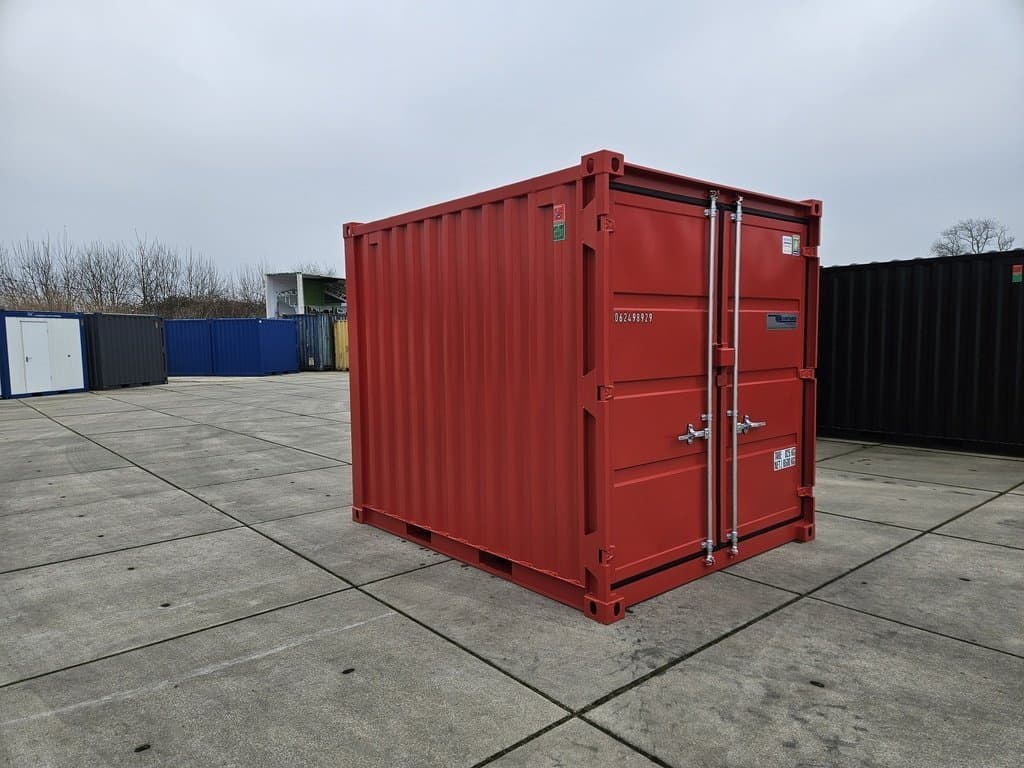
The 10-foot shipping container is a reduced-size model that retains the fundamental characteristics of standard ISO containers. At around three metres long, it is a compact unit suited to sites where available space is limited, while keeping the robustness and functionality of a classic container. This format is particularly popular for site storage, transporting bulky but not necessarily long goods, or as a base for modular conversions. In this description, we detail its technical aspects, common uses, points to check when buying and the regulatory considerations for its transport and installation in France.
To begin with, it is worth recalling the standard dimensions of this type of container. Measurements are generally expressed in imperial units, one foot equalling 30.48 centimetres. A 10-foot container therefore has external dimensions of approximately 2.98 metres long, 2.44 metres wide and 2.50 metres high. Inside, the usable space is around 2.83 metres long, 2.32 metres wide and 2.41 metres high. These values may vary slightly depending on manufacturers and exact specifications, but they form the standard basis. The empty weight, known as tare, is around 825 kilograms. The payload capacity then depends on the design, but is generally around several tonnes, allowing heavy goods to be carried. It is important to note that these containers are built from Corten steel, a low-alloy steel offering excellent resistance to atmospheric corrosion. This extends the container's lifespan, even when exposed to the weather.
The container's structure is designed to be completely weathertight. It has no ventilation or cooling system, which places it in the dry container category. This means it is intended for transporting and storing dry goods that do not require specific temperature or humidity control. The double doors at one end provide wide access and make loading and unloading easier. These doors are fitted with seals and robust locking mechanisms, ensuring secure closure. The floor, usually of hardwood or marine plywood, is treated to withstand moisture and heavy loads. The side walls and roof are made of corrugated steel sheets, providing rigidity and impact resistance. Finally, the base is reinforced with steel cross members, allowing lifting and movement with suitable handling equipment.
One of the main advantages of the 10-foot container is its versatility. Thanks to its compact size, it can be installed in restricted spaces where a 20 or 40-foot container would not fit. It is therefore commonly used as a storage unit on construction sites, for tools, materials or sensitive equipment. Car dealers, craftsmen or traders may also see it as a secure storage solution for various goods. In transport, it can be loaded onto trucks, trains or ships, and its handling is made easier by standard corner castings that allow slinging and locking onto vehicles. In addition, its relatively low empty weight simplifies lifting operations and reduces transport costs.
Another frequent use is conversion into a workspace or technical room. With a little adaptation, a 10-foot container can be turned into a site office, a security cabin, a storage room for hazardous products (subject to compliance), or even a small temporary living unit. Its insulation can be improved by adding insulating materials, and extra openings (doors, windows) can be created, subject to building and planning rules. For any conversion, it is essential to consider ventilation, electricity and drainage, but these modifications go beyond the scope of the standard container.
When buying a new 10-foot container, several points should be checked. First, make sure the container is genuinely new, meaning it has never been used for sea transport. A new container is generally delivered with fresh paint, no traces of rust, and intact door seals. It should come with a certificate of conformity to ISO 668 (which defines dimensions and classifications) and ISO 1496 (which specifies design and testing requirements). These certifications guarantee that the container has successfully passed strength and weathertightness tests. Also check for the CSC (Convention for Safe Containers) plate, which attests to compliance with international safety standards. This marking is mandatory for containers used in international transport. Even if you intend to use your container statically, having these guarantees is reassuring.
Another important aspect is the quality of the paint and anti-corrosion protection. A new container should be coated with epoxy or polyurethane paint, applied in several layers, to protect the Corten steel. Check that there are no runs, bubbles or unpainted areas. Welds should be regular and free of visible defects. The floor should be free of large knots, cracks or deformation. The doors should open and close without forcing, and the seals should be supple and well fixed. Finally, inspect the corner castings: they should be in good condition, without excessive wear, as they are used for handling and locking.
If you buy a used container, the checks are even more crucial. A used container may have been exposed to sea air, which accelerates corrosion. Look for perforating rust, especially on the roof and side walls. Check the condition of the floor: it may be rotten or sagging. Make sure the doors close properly and the seals are not cracked. A used container may also have been repaired; in that case, repairs must be carried out properly, with sheets of the same thickness and suitable paint. If possible, ask for the container's history (number of voyages, goods carried) and a recent inspection certificate. The price of a used container is generally lower than a new one, but it may require maintenance work.
In terms of maintenance, a 10-foot container requires little care but regular monitoring. It is advisable to clean the surface at least once a year with a hose and mild detergent to remove dirt and salt deposits. Check the door seals and replace them if worn. Inspect any emerging rust spots and treat them with rust remover then finishing paint. If the container is placed on the ground, make sure it rests on stable supports (concrete blocks) to avoid direct contact with ground moisture. This also helps air circulation under the floor and prevents corrosion. If storing moisture-sensitive goods, adding dehumidifiers can be useful, as even a weathertight container can experience condensation due to temperature variations.
Transporting a 10-foot container in France is subject to certain rules. On the road, it can be carried on a container truck, provided the total weight (container plus load) respects the vehicle's load limits and the Highway Code. The container must be properly secured using twist-locks or suitable straps. If you need to move it over long distances, it is advisable to use a specialist carrier. For sea transport, the container must be CSC certified and meet ISO standards. Finally, for installation on a plot of land, planning permission may be required, especially if the container is used as a dwelling or business premises. Check with your local town hall for local rules.
To complete these initial points, let us look in more detail at sector-specific use cases that make the 10-foot container a solution of choice. In construction, it is frequently used as a site store for valuable tools, spare parts or consumables. Its small size allows it to be positioned close to work areas, even on cluttered sites. Public works companies also use it as a pumping station or shelter for sensitive electronic equipment. In events, it serves as a technical control room, storage for sound and lighting equipment, or a temporary changing room. Farmers see it as a way to store seeds, fertilisers or small equipment, protected from moisture and rodents. Individuals can use it to store furniture, bicycles, garden tools, or as a DIY workshop. Finally, in urban logistics, it can serve as a micro-consolidation platform for last-mile deliveries, a growing trend in space-scarce cities.
Let us now compare the 10-foot container with other standard formats. The 20-foot container, the most widespread, offers a length of around 6.06 metres and an internal volume of around 33 cubic metres. It is better suited to transporting bulky goods and storing large quantities. The 40-foot container, 12.19 metres long, is ideal for international moves and large palletised loads. The 40-foot high cube, with an internal height of around 2.69 metres, offers extra volume for light, bulky goods. The 10-foot container, at 2.98 metres long, sits at the bottom of the scale. It is more manoeuvrable, easier to move with a forklift or crane truck, and can be installed on sloping or small plots. Its internal volume is around 15 cubic metres, which remains sufficient for many domestic or craft uses. In terms of weight, its tare of 825 kg is well below that of a 20-foot (around 2,200 kg) or 40-foot (around 3,800 kg), reducing transport costs and handling constraints. However, its cost per cubic metre stored is generally higher than that of a large container, as the structure and doors represent a significant fixed share. The choice will therefore depend on use: for an occasional need and limited space, the 10-foot is relevant; for bulk storage, a 20-foot will be more economical.
There are also variants of 10-foot containers, such as open top (removable roof) or flat rack (no side walls) models, which allow out-of-gauge goods to be loaded. These versions are less common but can be ordered. The 10-foot reefer (refrigerated) container is rare, as demand is concentrated on larger sizes. Finally, the 10-foot high cube container is not standard; the height generally remains 2.50 metres. If you need more height, you will need to consider a 20-foot high cube.
Let us now address the regulations specific to transport and installation in France. For road transport, a 10-foot container can be loaded onto a flatbed truck or container truck. The authorised gross train weight must not exceed 40 tonnes for an articulated combination, and the truck's payload must be respected. The container must be secured in accordance with ADR rules for dangerous goods, where applicable. If the container is used as packaging for dangerous goods, it must meet ADR requirements and be certified. For sea transport, the container must have a valid CSC plate and be inspected periodically. In France, using a container as a dwelling or office is subject to the Town Planning Code. Depending on the case, a prior declaration of works or a building permit may be required. Containers are considered removable or non-removable structures, and their installation must comply with safety, accessibility and insulation rules. It is advisable to consult your local planning department before any fixed installation.
Finally, for long-term maintenance, it is useful to keep a maintenance log. Note the dates of cleaning, paint touch-ups and seal replacement. Inspect the container after each episode of high wind or storm. Check that the corner castings are not cracked. If the container is used to store food products, make sure it is clean and free of chemical residues. Steam cleaning may be necessary. For extra protection against moisture, you can apply a water-repellent coating to the floor. Finally, if the container is to be moved frequently, consider buying castors or sliding skids to make manoeuvring easier.
In conclusion, the 10-foot container is a practical, robust and modular solution for many needs. Whether for storage, transport or conversion, it offers a compact alternative to larger containers. Its Corten steel, double doors and weathertightness make it a durable product. Before buying, check compliance with standards, overall condition and any delivery costs. Regular maintenance will extend its lifespan. Finally, comply with current regulations for its transport and installation. This container will meet your expectations, provided you take the time to choose the model suited to your use.