Description
The 20ft Open Side shipping container with integrated drip tray is a storage solution designed for the handling and containment of polluting or flammable substances. It combines the robustness of a standard shipping container with a liquid retention system integrated into the floor, thus meeting common environmental safety requirements in industrial environments. This product is available for sale and rent, in new or used versions, and is suitable for both permanent on-site use and temporary use on construction sites.
Dimensionally, this container complies with the nominal specifications of the 20ft format. Its external dimensions are 6,058 mm long, 2,438 mm wide and 2,591 mm high. Its internal dimensions are 5,844 mm long, 2,224 mm wide and 2,299 mm high. The front door opening measures 2,114 mm wide by 2,169 mm high. The useful internal volume is 29.90 m³. The tare weight is 4,200 kg, the maximum payload is 26,280 kg and the maximum gross weight of the cargo is 30,480 kg. These values correspond to the common characteristics of standard 20ft containers and allow anticipating handling and transport needs.
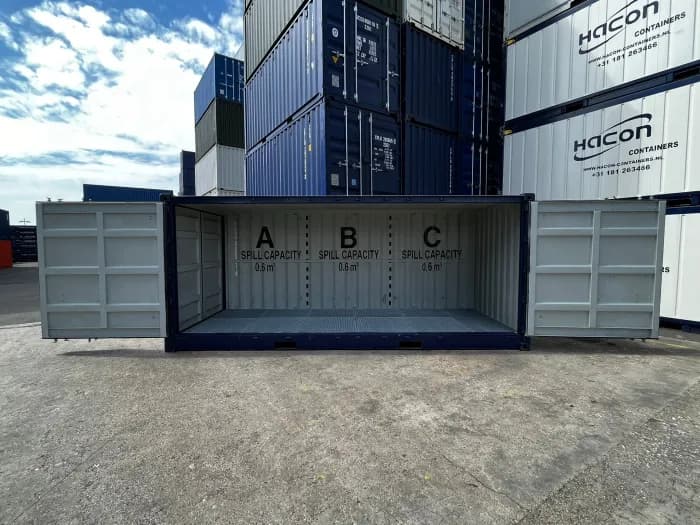
The particularity of this model lies in its integrated drip tray. It is divided into three distinct compartments, identified A, B and C, each with a capacity of 0.6 m³. This segmentation allows physically separating different types of products or containing potential leaks separately. The tray is covered with a liquid-tight steel floor, which prevents any infiltration to the outside and facilitates the recovery of products in case of accidental spillage. This steel floor is a more resistant and durable option than traditional wooden floors, particularly for environments where chemicals or hydrocarbons are handled.
In addition to the standard front doors located on the front face, this container is equipped with side doors along the entire length of one long side. This Open Side configuration offers full side access, which facilitates loading and unloading of bulky goods or pallets, including with a forklift. Side access is particularly appreciated in configurations where ground space is limited and where it is not possible to use the front doors. The side doors are equipped with a locking box to secure the contents.
The structure is made of Corten steel, a low-alloy steel that offers superior resistance to atmospheric corrosion compared to conventional carbon steels. This material is commonly used in the construction of shipping containers for its durability and ability to withstand weathering. The container is certified C.S.C. (Convention for Safe Containers), which attests to its compliance with international safety standards for shipping containers. It also complies with applicable ISO standards, including ISO 668 for dimensions and ISO 1496 for technical specifications.
The container is equipped with standard ventilation vents, which allow natural ventilation of the interior space. This feature is important for storing substances that may release vapors or to prevent condensation. The standard color is RAL 5013, a dark blue, but the container can be supplied in all RAL shades on request, which allows harmonizing it with a site's graphic charter or visually marking a specific storage area.
Stacking is possible, which optimizes the use of vertical space on a storage site. The container is forklift compatible, which facilitates handling and moving operations. It is important to note that the total loaded weight must not exceed 30,480 kg, and stacking rules must be respected to ensure safety.
This type of container is particularly suitable for storing polluting and flammable substances. Retention trays are commonly used to contain leaks of chemicals, oils, solvents or other hazardous liquids. The presence of three compartments allows separating different categories of products, thus reducing the risk of undesirable reaction in case of accidental mixing. The liquid-tight steel floor provides an additional barrier against infiltration into the ground.
When purchasing a container of this type, several points of vigilance must be examined. The general condition of the structure should be checked, including the presence of perforating rust, deformations or cracks. The doors must open and close properly, and the seals must be in good condition. The retention tray must be inspected to ensure there are no leaks and that the compartments are intact. The CSC certification must be valid and up to date. For a used container, it is recommended to request a recent inspection report.
Regarding transport regulations in France, the transport of shipping containers is subject to specific rules. The total loaded weight must not exceed the limits authorized by the highway code for the transporting vehicle. Containers must be properly secured on the vehicle. For the transport of dangerous goods, additional regulations apply, including ADR (European Agreement concerning the International Carriage of Dangerous Goods by Road). It is the user's responsibility to ensure that the container is used in accordance with applicable regulations.
Maintenance of an Open Side container with retention tray involves regular inspection of the condition of the paint and metal surfaces. Scratches and paint chips must be treated quickly to avoid corrosion. The retention tray must be cleaned after each use to avoid accumulation of residues. Door seals must be checked and replaced if necessary. Hinges and locking mechanisms must be lubricated periodically.
To go deeper into maintenance, it is useful to distinguish preventive maintenance operations from those to be carried out after an incident. Preventive maintenance includes a monthly visual check of welds, hinges and seals, as well as regular cleaning of the retention tray using products compatible with the stored residues. It is advisable to check for the absence of stagnant liquid in compartments A, B and C, even in the absence of visible leakage, as condensation can accumulate there. Once a year, a more complete examination can include checking the flatness of the steel floor, verifying paint adhesion and inspecting the underbody, areas often exposed to splashes and humidity. In case of accidental spillage, the product should be wiped up quickly, the affected compartment rinsed with a suitable neutralizing product, then carefully dried before being put back into service. Detergents used must be compatible with Corten steel and not promote corrosion. For containers exposed at the seaside, rinsing the exterior surfaces with clean water limits the accumulation of salt, which is particularly aggressive for steels even when protected.
From a regulatory standpoint, the use of a container with retention tray falls within the broader framework of regulations on installations classified for environmental protection (ICPE) when the site stores hazardous substances. Depending on the nature and volumes of products, a declaration, registration or prefectoral authorization may be required. The container with retention tray can contribute to compliance with containment obligations, but it does not exempt from a site-specific risk analysis. For road transport, a loaded 20ft container can be transported on a container carrier or a container truck. The total loaded weight (30,480 kg) must be compared with vehicle limits and traffic rules. In France, exceptional transport may be necessary if dimensions or weight exceed regulatory thresholds. The transport of dangerous goods by road is governed by ADR, which imposes marking, documentation and specific equipment. Finally, for maritime transport, CSC certification is essential and must be kept in force.
Sector-specific use cases for this container are varied. In the chemical industry, it allows storing drums, cans or IBCs containing corrosive or flammable products, with appropriate retention in case of leakage. In the oil and gas sector, it can be used for storing oils, lubricants or solvents on operating or maintenance sites. Mechanical workshops and garages find in it a solution for storing used oils, filters or parts soaked in hydrocarbons. The pharmaceutical sector can use it for laboratory chemicals or hazardous waste. Local authorities and professional waste collection centers can store hazardous waste awaiting disposal. Finally, public works or remediation companies can group absorbent products, solvents or construction site residues there. In all these cases, full side access facilitates handling of pallets and intermediate bulk containers (IBCs), often used for these products.
Compared to other formats, the 20ft Open Side container with retention tray stands out for its compactness and modularity. A 40ft container offers a larger internal volume, but it is less suitable for sites where maneuvering space is limited. A 10ft container is easier to move, but its retention volume is necessarily smaller. The 20ft format represents a common compromise between capacity and footprint. Compared to a standard dry container, the Open Side version provides side access that simplifies loading, but it is generally heavier and more expensive. Compared to an open top container, which is loaded from above, the Open Side favors side access, which is better suited to pallets and wide loads. The liquid-tight steel floor also distinguishes it from containers with wooden floors, which are more sensitive to humidity and chemicals. Finally, the integrated retention tray avoids having to add an external retention tank, which simplifies installation and reduces ground footprint.
When choosing between a new and a used container, several criteria come into play. A new container offers a guarantee of watertightness and intact paint, which facilitates maintenance and compliance. A used container may be more economical, but its condition must be examined carefully, particularly the retention tray and side doors. In both cases, it is recommended to check the presence of the CSC plate and its validity date. Renting may be relevant for a temporary need, for example during a remediation site or a one-off maintenance operation. Purchasing is more suitable for regular use over several years.
Finally, the placement of the container on the site deserves prior consideration. It must be placed on a flat and stable surface capable of supporting its total loaded weight. A slight slope can compromise door opening and proper distribution of liquids in the tray. It is advisable to provide maneuvering space for forklifts and to check safety distances from other installations. If the container is stacked, stacking rules must be respected and lifting corners must be used. Appropriate signage can be put in place to identify storage areas and remind safety instructions. Finally, it is useful to record inspections and maintenance interventions in a log, which facilitates monitoring and traceability.
In summary, the 20ft Open Side container with retention tray is a versatile solution for the safe storage of hazardous substances. Its technical characteristics, including its standard dimensions, divided retention tray, liquid-tight steel floor and full side access, make it equipment suited to the needs of the chemical, oil, pharmaceutical industries or any other activity handling potentially polluting products. Available for sale and rent, new or used, it can be configured according to the specific needs of each user.