Description
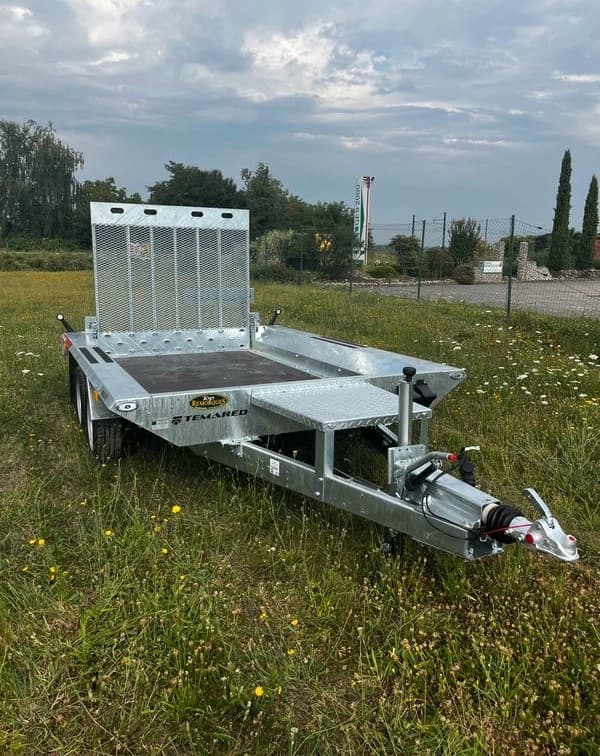
The TEMARED Builder3015 S plant trailer is transport equipment designed to move compact machinery and heavy loads on the road. With a 3.00 m long and 1.50 m wide bed, it offers a versatile loading area, suitable for mini excavators, compact loaders and tillers as well as professional mowers, quads and various tools. Its robust design and standard equipment make it a popular choice among tradespeople, landscapers, equipment rental companies, local authorities and equipped individuals. This document details its technical specifications, practical uses, points to watch when buying, and the maintenance and safety rules to follow for smooth, long-lasting use.
The loading bed has useful dimensions of 3.00 m x 1.50 m, with 0.30 m high side rails. This configuration allows the transport of wheeled or tracked machinery, as well as bulk materials, pallets or furniture, thanks to the rails that hold loads in place. The floor, generally made of treated wood or anti-slip steel depending on the version, supports concentrated loads and resists road vibrations. The wide ramp, tilting or removable depending on the configuration, facilitates loading and unloading of wheeled or tracked machinery. It is recommended to check the ramp angle and capacity before each use, and to use distribution plates for tracks to avoid marking the floor.
The chassis is made of steel, the reference material for plant trailers due to its mechanical strength and ease of repair. The structure is sized to withstand the forces of loading wheeled machinery and road stresses. The V-shaped drawbar contributes to the rigidity of the assembly and improves tracking in a straight line and during manoeuvres. Two braked axles, each rated at 1,500 kg, distribute the load and enhance stability in motion. The 195/50R13C tyres are sized to support the load and provide good traction on firm ground; their common size makes replacement and access to parts easier. The automatic jockey wheel simplifies hitching and moving when empty. Plastic wheel chocks are supplied to immobilise the trailer when parked, and a bucket rest is provided to secure or hold certain equipment during transport.
With a GVW of 3,000 kg, this trailer falls into the category of braked trailers that can be towed with a category B licence under conditions, or with a BE licence depending on the towing vehicle configuration and the gross train weight (GTW). The actual payload depends on the trailer's kerb weight, generally between 400 and 600 kg for this type of plant trailer. The theoretical payload is therefore around 2,400 to 2,600 kg, but the manufacturer's plate or registration document should be consulted for the exact value. This GVW is a widespread standard that offers a good balance between transport capacity and towing ease, compatible with many common vans and 4x4s, subject to complying with the GTW and any load transfer.
One of the strengths of the Builder3015 S lies in its comprehensive standard equipment: two braked axles, a wide ramp, an automatic jockey wheel, wheel chocks and a bucket rest. These items are not always included on entry-level models, where the ramp may be optional, the jockey wheel manual, and the chocks absent. The bucket rest, in particular, is a popular accessory for mini excavator users: it allows the bucket to be placed stably during transport, preventing it from moving or damaging the floor. The wide ramp facilitates access for wheeled or tracked machinery, provided the ramp angle is respected and the ramp is checked to support the machine's weight. For tracks, it is recommended to use suitable ramps or distribution plates to avoid marking the floor.
The sector-specific use cases for this trailer are numerous. In construction and public works, it allows the transport of a 1.5 to 2.5 tonne mini excavator, a compactor, a vibrating plate, a generator or materials. Landscapers use it to move a ride-on mower, topsoil, paving stones or shrubs. Farmers load small equipment, fencing, beehives or caged animals. Local authorities use it for green space maintenance, transporting street furniture or road maintenance equipment. Equipment rental companies appreciate its versatility and ease of hitching. Finally, individuals with a van or 4x4 can use it for personal projects, transporting a quad, a tiller or building materials.
Compared to other types of trailers, the plant trailer stands out from the single-axle trailer by its load capacity and stability, and from the forage trailer by its open design and ramp. It also differs from the classic side-rail flatbed by its ramp and reinforced floor, designed for rolling loads. Compared to a plant truck, it offers the advantage of being towable by a light vehicle, without requiring a heavy goods licence, and costs less to buy and maintain. However, it imposes weight and speed limits, and its use remains dependent on the towing vehicle's capacity.
To choose this trailer well, it is useful to understand how it fits among other models on the market. Plant trailers generally come in several bed sizes: 2.50 m x 1.25 m, 3.00 m x 1.50 m, 3.50 m x 1.75 m or 4.00 m x 2.00 m. The Builder3015 S, with its 3.00 m x 1.50 m, represents a common compromise: large enough to accommodate a mini machine or small tractor, but compact enough to remain manoeuvrable in yards, narrow driveways and cluttered worksites. A larger model will offer more surface area but increase kerb weight, turning radius and parking constraints. Conversely, a smaller model will be better suited to micro-machines and individuals with limited storage space, but will quickly be limited for larger equipment.
Using the trailer must comply with several safety rules. The load must be secured with suitable straps or chains, using the anchor points provided for this purpose. The weight must be distributed evenly, with a slight bias towards the front to maintain good roadholding, without exceeding the maximum nose weight allowed by the towing vehicle (generally 50 to 75 kg for a standard hitch, but check the vehicle manual). The indicator lights, turn signals and brake lights must work correctly and be connected to the vehicle's electrical socket. The trailer's registration plate must be visible and lit. If overloaded, road behaviour deteriorates and the risk of accidents increases.
Routine maintenance of the TEMARED Builder3015 S revolves around a few simple but essential actions. Before each use, check tyre pressure when cold, inspect tyre condition (wear, cuts, bulges), test the lighting and signalling, ensure the jockey wheel works correctly and the hitch is secure. After each use, cleaning the bed and lightly greasing the joints (ramp, drawbar, axles) extends service life. Braked axles require periodic checking of the linings and brake adjustment; a professional can carry out this check. Wheel bearings must be greased according to the manufacturer's recommendations, generally every 5,000 to 10,000 km or once a year in intensive use. The electrical wiring must be inspected for wear or corrosion. Finally, the floor must be checked for cracked boards or corroded areas, and replaced if necessary.
From a regulatory standpoint, in France, a trailer with a GVW exceeding 500 kg must be registered and have a registration document. Insurance is compulsory to drive on public roads. The driver must hold a suitable licence: a category B licence allows driving a trailer if its GVW does not exceed 750 kg, or if the trailer's GVW is over 750 kg but the sum of the GVWs (vehicle + trailer) does not exceed 3,500 kg and the trailer's GVW does not exceed the kerb weight of the towing vehicle. Beyond that, a BE licence is required. It is also necessary to comply with trailer-specific speed limits (110 km/h on motorways, 100 km/h on dual carriageways, 80 km/h on other roads, unless otherwise signed). The load must not exceed the size limits (width 2.55 m, height 4 m, length 18.75 m for a combination). If the load extends more than 3 metres beyond the rear of the trailer, a signalling device (board) is compulsory. Finally, the gross train weight (GTW) of the towing vehicle must not be exceeded.
When buying, several points should be examined. It is advisable to check the trailer's conformity (CE marking, manufacturer's plate, serial number), the condition of the chassis (corrosion, welds), the operation of the brakes and jockey wheel, the presence of all advertised equipment (ramp, chocks, bucket rest), and the consistency between GVW, kerb weight and payload. An empty test run can detect any abnormal noises or play in the axles. It is also recommended to check that the trailer is compatible with the towing vehicle's hitch (height, ball type, electrical socket). Finally, for intensive use, a well-maintained trailer stored under cover preserves its resale value.
To delve deeper into use and maintenance, it is useful to address the specifics of braking and suspension. The 1,500 kg braked axles are generally fitted with drum brakes, a proven system for trailers. Brake adjustment must be carried out by a professional, as an imbalance can cause wheel lock-up or ineffective braking. The suspension, often leaf springs or torsion bars depending on the version, must be inspected for broken leaves or worn bushings. A damaged axle can lead to uneven tyre wear and poor roadholding. It is therefore advisable to have the axles' alignment checked after an impact or intensive use.
Storing the trailer also deserves special attention. Ideally, it should be kept under cover, on flat, stable ground, with the jockey wheel in the low position to relieve the axles. If outdoor storage is unavoidable, a protective cover or regular anti-corrosion treatment of the chassis can limit damage. Tyres should be inflated to the recommended pressure and protected from sunlight to prevent cracking. It is also recommended not to leave a load on the bed for a long period, to avoid deforming the floor or suspensions.
Finally, for professionals who use the trailer daily, training staff in hitching, loading and securing is a safety guarantee. Knowing the load limits, being able to use the ramps and straps, and checking the trailer's condition before each trip are reflexes that reduce the risk of accidents and material damage. The TEMARED Builder3015 S, with its robust design and complete equipment, is a durable tool for these intensive uses, provided the manufacturer's instructions and current regulations are followed.
In summary, the TEMARED Builder3015 S is a versatile, robust and well-equipped plant trailer, suitable for many professional and private uses. Its 3.00 m x 1.50 m bed, 3,000 kg GVW and two braked axles make it a reliable tool for transporting machinery and equipment, in compliance with regulations and with proper maintenance.