Description
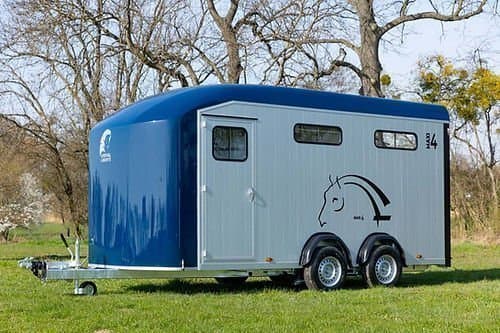
The BW TRAILERS 4-cage dog trailer with top box is equipment designed for the safe transport of several animals, with integrated storage space. It is aimed at breeders, dog clubs, training professionals or private owners who need to move four dogs in suitable conditions. Its single-axle design and 750 kg GVW make it drivable without an E licence, which simplifies everyday use.
The chassis of this trailer is sized for a gross vehicle weight of 750 kg. This limit corresponds to the light trailer category, towable with a B licence under certain combined-weight conditions. It means the load must be well distributed between the cages and the box so as not to exceed the GVW. The trailer rests on a single axle, making it manoeuvrable when parking and turning. The 155/80R13 tyres ensure good road stability and even wear. The jockey wheel makes it easier to move when empty or lightly loaded on parking areas and firm tracks.
The four cages have useful dimensions of 1.00 m long, 0.40 m wide and 0.80 m high. These volumes suit medium-sized dogs, giving each animal an individual space to stand, sit and lie down during transport. The separation into distinct cages limits interactions between dogs and reduces stress linked to overcrowding. The walls and partitions should be checked regularly to ensure they have no sharp edges or loose fixings. The floor is wooden, a common material in this type of trailer for its ease of maintenance and comfort underfoot. It is recommended to lay absorbent bedding or a non-slip mat to improve hygiene and animal comfort.
The integrated top box measures 2.00 m long, 1.25 m wide and 0.25 m high. It offers useful volume for carrying show equipment, bowls, leads, cleaning products or clothing. This box is built into the structure, avoiding the need to fit an add-on box and preserving the trailer's balance. However, care must be taken not to store too much heavy weight high up, so as not to impair roadholding. The load must be distributed to keep a low centre of gravity.
Use of this trailer falls under French regulations on trailers under 750 kg. This type of trailer does not need its own registration document, but must be fitted with a number plate reproducing that of the towing vehicle. Lighting and signalling must be compliant and in good working order. The driver must ensure the coupling is properly locked and that the tow ball supports the load. If the weight is exceeded, penalties can include a fine and immobilisation of the vehicle. It is therefore advisable to weigh the loaded trailer or to know precisely the weight of the animals and equipment carried.
For maintenance, a visual check before every trip is essential: tyre pressure, wheel bolt tightness, light operation, condition of the jockey wheel and coupling head. The wooden floor must be cleaned and disinfected regularly to limit odours and health risks. The cages must be aired after each use. Periodic checking of welds and structure helps detect any cracks. The 155/80R13 tyres must be replaced when they show uneven wear or cuts. Grease on the coupling head and jockey wheel extends their service life.
When buying, several points deserve attention. Check that the 750 kg GVW really matches actual needs and that the trailer has not been modified without updating its specifications. The condition of the wooden floor is a wear indicator: a swollen or rotten floor may need replacing. The cage partitions must be solid and correctly fixed. The top box must be watertight to protect equipment from rain. Finally, the presence of the jockey wheel and a complete lighting system is a sign of conformity.
This trailer can also be used for purposes other than dog transport, such as carrying light equipment or small furniture, within the GVW and cage dimensions. However, a trailer intended for dogs must remain clean and not be contaminated by chemicals or sharp objects. It is therefore preferable to reserve its use for animals or to clean it carefully after each mixed use.
In summary, the BW TRAILERS 4-cage trailer with top box is a functional tool for professionals and private owners who need to transport several dogs with storage. Its technical features (750 kg GVW, single axle, 155/80R13 tyres, cages 1.00 x 0.40 x 0.80 m, top box 2.00 x 1.25 x 0.25 m) make it a solution suited to regular use, provided loading and maintenance rules are followed.
To explore the use of this trailer further, it is useful to detail sector-specific use cases. Professional dog breeders use this type of trailer to present their dogs at shows or competitions. The separation into four cages allows animals of the same breed or different breeds to be transported without mixing. Agility or obedience clubs appreciate the ability to take several dogs to the same site. Rural vets can use it for home visits, but must then provide specific storage for medical equipment. Shelters and animal welfare associations use it for transfers between sites or for adoption operations. Finally, multi-dog private owners find it a solution for holidays or family trips.
In hunting, this type of trailer can transport hunting dogs over varied terrain. Ground clearance and 155/80R13 tyres allow driving on unpaved tracks, provided speed is reduced. For dog sports such as canicross or bikejoring, the trailer serves as a logistics base at competition venues. Dog trainers can store teaching equipment in the top box. Mobile groomers could consider using it, but the lack of running water and on-board electricity limits this application without additional fitting.
Let us compare this 4-cage trailer with other configurations. A 2-cage trailer generally offers larger cages, which suits large dogs, but carries fewer animals. A 6-cage trailer maximises capacity, but each cage is narrower and the GVW may approach the 750 kg limit, reducing the loading margin. The 4-cage model represents a compromise between capacity and individual space. The integrated top box is an advantage over trailers without storage, which force use of the towing vehicle's boot. In terms of dimensions, the 2.00 m x 1.25 m x 0.25 m box offers a volume of around 0.625 m³, useful for bulky but light items.
Regarding regulations, a distinction must be made between trailers under 750 kg and heavier trailers. For a trailer of 750 kg or less, a B licence is enough, but if the trailer's GVW exceeds 750 kg, an E(B) licence becomes mandatory in certain cases. Here, the GVW is exactly 750 kg, so no E licence is required. However, the towing vehicle's gross train weight (GTW) must be respected. It is advisable to check the vehicle registration document to find the GTW and maximum towable weight. In France, a trailer under 750 kg must be fitted with a compliant coupling device, position lights, brake lights, indicators and a reflector. The number plate must be that of the towing vehicle, in a legible font. During checks, a missing plate or faulty lighting can lead to a fine.
For long-term maintenance, it is recommended to check the condition of the chassis and welds once a year. A pressure washer can be used on the metal structure, but the wooden floor should not be excessively wetted. Treating the wood with a suitable stain or paint extends its life. Wheel bearings must be greased or replaced according to wear. The jockey wheel must be kept clean and greased. Tyres must be inflated to the manufacturer's recommended pressure, usually shown on the tyre sidewall. Too low a pressure increases fuel consumption and wear. Too high a pressure reduces grip. It is also advisable to check wheel nut torque after the first few kilometres of a trip.
In terms of safety, transporting live animals means dogs must not be left in the trailer in full sun without ventilation. The cages must be ventilated, but not directly exposed to strong wind. In winter, a blanket or insulating mat can be added. It is forbidden to transport animals in extreme temperature conditions. The driver must adapt their driving: progressive braking, gentle turns, avoiding potholes. The trailer must not be overloaded and the weight must be evenly distributed. An imbalance can cause snaking, which is dangerous at high speed. The recommended maximum speed for towing a trailer is often limited to 90 km/h on motorways in France, and 80 km/h on roads, depending on current regulations. It is prudent to reduce these speeds in wind or on degraded surfaces.
For interior fitting, some users add fans powered by an auxiliary battery, or watering systems. These modifications must be carried out in compliance with electrical safety rules and must not compromise the structure. Adding interior lighting can make loading dogs easier in the morning or evening. A non-slip floor covering is a plus. Partitions can be lined with sound-insulating material to reduce animal stress. Any modification must be declared if it changes the GVW or technical specifications.
In conclusion, the BW TRAILERS 4-cage trailer with top box is a versatile model for dog transport. Its dimensions, 750 kg GVW and equipment (wooden floor, jockey wheel, single axle, top box) make it a sound base for regular use. The buyer must check conformity, general condition and comply with loading and maintenance rules. With proper maintenance, it can support dog travel for many years.
A few practical points rarely covered in product sheets remain to be addressed. The first concerns weight distribution between the four cages. With each dog occupying a cage, it is advisable to balance the heaviest animals on either side of the axle, rather than all on the same side. Asymmetric loading prematurely wears tyres and strains the suspension. The second point concerns ventilation: if the trailer is closed, sufficient air vents must be present. Without forced ventilation, a trip in high heat can be dangerous. It is preferable to travel early in the morning or in the evening during heatwaves. The third point concerns access: cage doors must open and close without forcing, with reliable latches. A vibrating latch can open while driving, which is a serious risk. A check before every departure is therefore essential.
Another often neglected aspect is storing the trailer between uses. Ideally, it should be parked on flat ground, sheltered from the weather if possible. A protective cover over the box and cages limits the build-up of leaves and water. The jockey wheel should be lowered to avoid putting weight on the coupling. If the trailer stays outside, regularly check that water does not stagnate in the top box. A drainage hole or slight roof slope can help. The wooden floor, if exposed to moisture, can become mouldy; preventive treatment is recommended.
As for compatibility with the towing vehicle, check that the tow ball is the correct diameter, generally 50 mm in Europe. The ball height must be suitable so that the trailer remains horizontal. A trailer tilted too far forward or backward changes weight distribution and can make driving unstable. The electrical harness must be compatible with the vehicle socket (7 or 13 pin). An adapter may be needed. It is advisable to test the lights after coupling, turning on the indicators, position lights and brake lights. Faulty lighting can lead to a fine and endangers other road users.
Finally, commercially, this trailer sits in a price range of 2,500 euros, which corresponds to a model equipped with an integrated box. Trailers without a box are generally cheaper, but offer less storage. Models with larger cages or a higher GVW may be more expensive and require an E licence. The buyer must therefore weigh up the number of dogs to transport, their size and the budget. The BW TRAILERS 4-cage trailer with top box is suitable for regular use with medium-sized dogs, and its price includes the top box, which adds real practical value.