Description
The LIDER "Robust 40380" flatbed trailer is designed for transporting heavy or bulky loads, with a gas-spring-assisted tilting bed that reduces loading effort. Its 1000 kg GVW and braked axle make it a versatile solution for professionals and individuals alike. We detail here its features, uses, maintenance and the regulatory points to know in France.
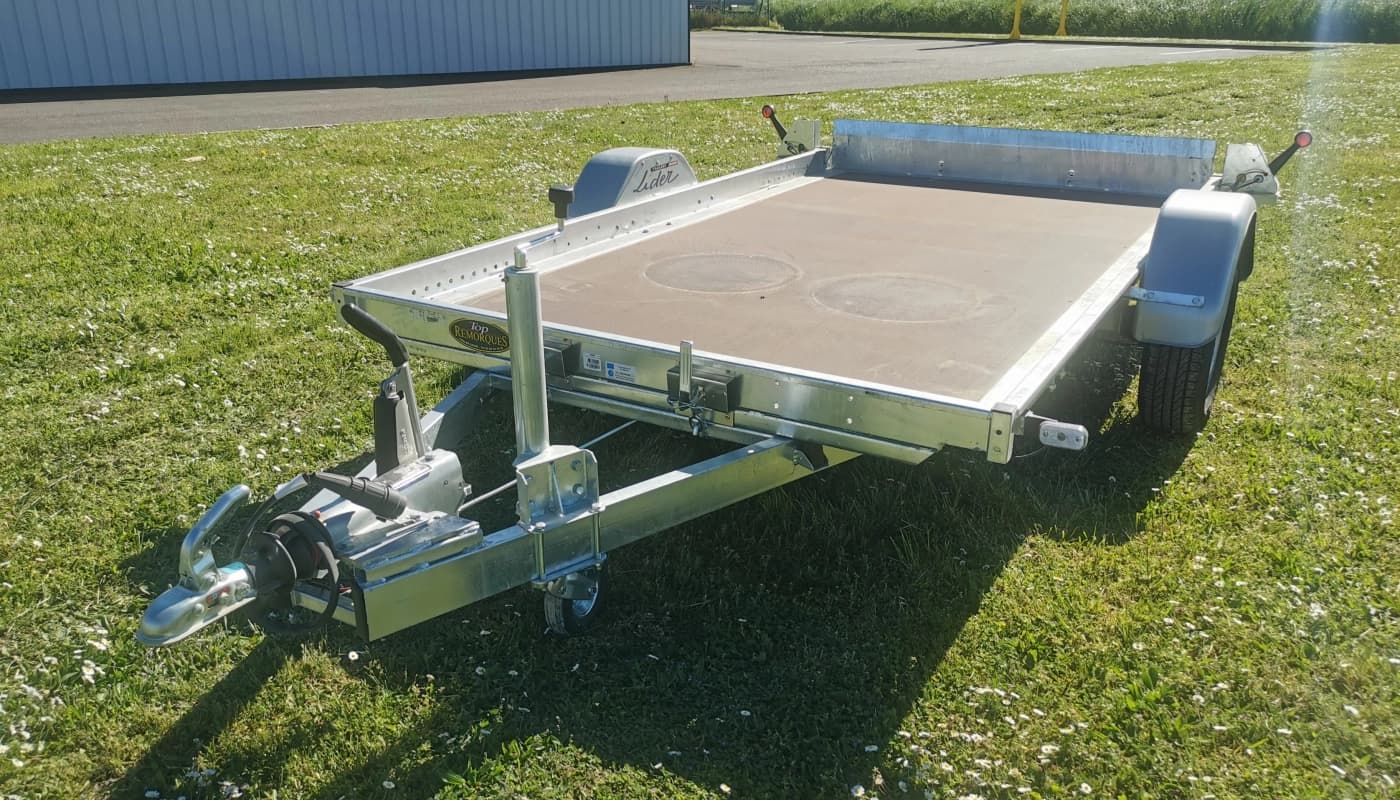
The tilting bed is the main asset of this model. Thanks to a gas-spring-assisted mechanism and tilting handles, the front of the bed tilts toward the ground, which lowers the ramp angle and makes it easier to load heavy or wheeled objects: wheelbarrows, mowers, tillers, small machinery. Once the load is positioned, the bed returns to the horizontal position for transport. The outer wheels, mounted outside the chassis, improve stability and allow side access across the full width, an advantage for wide loads such as panels or sheets.
The usable dimensions of the bed are 3.04 m long, 1.71 m wide and 0.10 m side height. This surface offers a usable volume of about 0.52 m³ for distributed loads. The plywood floor resists heavy loads and weather while providing a non-slip surface. A 20 cm mini tailgate retains loads in case of slight tilt and secures the transport of small objects. Integrated lashing loops allow the load to be secured with straps or ropes without drilling the bed.
The trailer is equipped with a braked axle rated at 1000 kg. Braking is essential to control the inertia of a loaded trailer, especially downhill or during emergency braking. The GVW (Gross Vehicle Weight) is 1000 kg, and the empty weight is 315 kg, which allows a maximum payload of 685 kg. Respecting this limit is essential for safety and regulatory compliance. The V-shaped drawbar ensures good towing stability and balanced distribution of forces. The automatic Ø60 mm jockey wheel facilitates maneuvers when stationary, hitched or not.
The wheels are fitted with 185/70R13 tires, a common size that offers a good compromise between comfort, grip and replacement cost. The trailer is delivered with regulatory lights (position, stop, indicators, license plate) and a coupling device compatible with standard 50 mm balls. A license plate holder is provided at the rear. The steel chassis is protected by anti-corrosion paint, ensuring good durability even under intensive use.
In France, any trailer with a GVW over 500 kg must be registered and have its own registration document. With a GVW of 1000 kg, the LIDER Robust 40380 is therefore concerned. A B license is sufficient to tow a trailer if its GVW is less than or equal to 750 kg, or if the sum of the GVWs (towing vehicle + trailer) does not exceed 3500 kg. With 1000 kg GVW, you must check that the GVW of the towing vehicle added to 1000 kg does not exceed 3500 kg (or 4250 kg with the B96 license). For example, if your car has a GVW of 2000 kg, the combination totals 3000 kg, which remains authorized with a B license. Otherwise, the BE or B96 license is required. Trailer insurance (at minimum civil liability) is mandatory, as is regular maintenance.
When purchasing, several points deserve verification. For a new trailer, ensure that the certificate of conformity and the user manual are provided, and that all standard equipment is present (lights, jockey wheel, lashing loops, etc.). For a used trailer, check the condition of the floor (rot, cracks), rust on the chassis, tire wear, operation of the brakes and tilt, and compliance of the lights. A test run empty and loaded is recommended. Check that the serial number matches the registration document. The braked axle requires regular inspection of the braking system (linings, cables, linkage) by a professional.
Routine maintenance includes cleaning the floor after each use, checking tire pressure (about 2.5 bar for 185/70R13, to be adjusted according to load), greasing the pivot points (axle, jockey wheel, tilt mechanism) and checking the lighting before each trip. In winter, wash the chassis to remove road salt. Storage under cover is ideal; otherwise, a tarp protects the bed. Wear parts (tires, bearings, brake linings) are available through the LIDER distribution network.
The uses of this trailer are varied. It is suitable for building tradespeople for transporting equipment (scaffolding, concrete mixers, tools), for landscapers for soil, plants or gravel, for individuals for moving, buying furniture, transporting motorcycles or quads (with ramps), or disposing of green waste at the recycling center. The tilting bed facilitates loading heavy loads without a ramp, and the outer wheels allow loading across the full width, an asset for wide loads.
Compared to other trailers, the LIDER Robust 40380 positions itself as a robust and versatile model. Its 1000 kg GVW is a good compromise for mixed use: sufficient for most domestic and trade needs, while remaining towable by a passenger car. Its braked axle provides additional safety compared to unbraked trailers. The gas-spring-assisted tilt reduces physical effort. The 20 cm mini tailgate retains loads, and the integrated lashing loops avoid drilling the bed. The V-shaped drawbar and automatic jockey wheel are appreciated for maneuverability.
To go deeper into maintenance, let us distinguish periodic operations from occasional interventions. Before each use, a quick visual check is required: tire condition (pressure, cuts, irregular wear), light operation (position, stop, indicators, plate light), presence and tightness of the jockey wheel, cleanliness of the floor. Every six months or every 5000 kilometers, check the tightness of the wheel bolts (to the prescribed torque, generally 90 to 110 Nm for this type of rim), the condition of the bearings (play, noise), and the proper operation of the parking brake. Once a year, a complete greasing of the drawbar joints, jockey wheel and tilt mechanism is recommended. The plywood floor should be inspected regularly: if splinters or rotten areas appear, partial or total replacement is necessary. A water-repellent treatment can extend its life.
The brakes on this trailer are of the inertia type, coupled to the towing vehicle's hitch. This system detects the trailer's push on the drawbar during deceleration and actuates the brake shoes. It is essential to check the linkage adjustment and lining wear. A poorly maintained braked axle can lead to braking imbalance, premature tire wear and loss of control. If in doubt, consult a professional. Replacing the linings is generally necessary after several thousand kilometers, depending on use.
Regarding transport regulations in France, several additional points should be specified. Registration is done with the ANTS via the online service, with a European certificate of conformity (COC) provided by the manufacturer. The registration document must be kept on board. The driver must have the license corresponding to the category of the combination, as well as the trailer's insurance certificate. During a check, the absence of a registration document or insurance can result in a fine. The license plate must be fixed at the rear, illuminated by a plate light. The trailer must be equipped with reflective devices (reflectors) and regulatory lights. The GTW of the combination must not exceed that indicated by the manufacturer of the towing vehicle. It is prohibited to transport people on the bed. The load must not exceed the size limits (width 2.55 m, height 4 m, length 12 m for a combination). If the load extends beyond the rear of the trailer, a warning device (red and white panel) must be attached, and the overhang must not exceed 3 meters. At night or in fog, a red light must signal the end of the load.
From a sector perspective, the LIDER Robust 40380 fits into many trades. Building tradespeople appreciate its ability to transport heavy materials (cement bags, bricks, tiles) and bulky tools (scaffolding, ladders, concrete mixers). The tilting bed makes it easy to unload rubble. Landscapers use it for topsoil, compost, mulch, potted plants, ride-on mowers. The tilt facilitates emptying. Farmers can use it for small equipment, fencing, fodder. Individuals see it as a versatile tool for moving, buying garden furniture, transporting motorcycles or scooters (with ramp), or disposing of green waste. Equipment rental companies often offer this type of trailer for its ease of use.
Compared to other sizes, the LIDER Robust 40380 sits in the 1000 kg GVW trailer category, with a bed of about 3 meters. It is an intermediate format between small unbraked trailers of 500 to 750 kg (often shorter, 1.50 to 2.50 m) and larger trailers of 1300 to 2000 kg (often twin-axle). The choice depends on needs: a 750 kg is lighter, towable by almost all vehicles, but its payload is limited (about 500 kg) and it is often unbraked. A 1300 kg offers a higher payload (about 1000 kg) but requires a more powerful vehicle and an appropriate license if the combination exceeds 3500 kg. The LIDER Robust 40380 represents a good compromise for those who need to transport moderate loads without changing vehicles or obtaining a special license. Its braked axle provides appreciable safety, especially on wet roads or downhill.
In terms of type, a distinction is made between flatbed trailers (like this one), box trailers (with sides), car carriers, dumpers, etc. The LIDER Robust 40380 is a flatbed trailer, without high side panels, with a 20 cm mini tailgate. This type of bed is ideal for loads loaded from above or from the sides, without side panel constraints. For transporting bulk loads, removable side panels or straps can be added. Versatility is therefore great.
Finally, let us mention the available accessories that can complement this trailer: access ramps for motorcycles or quads, additional side panels, protective tarps, support bars, strap kits, etc. These accessories are not supplied as standard but can be purchased separately. They increase functionality according to needs.
To summarize, the LIDER Robust 40380 trailer is a durable investment for those who need a reliable, safe and versatile transport tool. Its price of 2500.00 EUR is justified by its robust construction, braked axle and practical equipment. Before purchasing, check compatibility with your vehicle, make sure you have the appropriate license and plan for regular maintenance. For any questions, our team is at your disposal.
To complete this presentation, let us address some practical aspects rarely detailed but useful in daily life. Loading a tilting flatbed trailer follows mass distribution rules that determine the roadholding of the combination. It is recommended to place the heaviest loads above the axle, slightly forward of it, in order to maintain sufficient support on the hitch ball without overloading the drawbar. Too little support makes the combination unstable and can cause swaying, while excessive support strains the rear suspension of the towing vehicle and reduces front wheel grip. In practice, a tongue weight of about 5 to 8% of the total weight of the loaded trailer is targeted, which corresponds, for a payload of 685 kg, to a support of around 50 to 80 kg once the load is in place. A tongue scale or a simple visual check of the vehicle's stance can verify this point before taking to the road.
Securing the load also deserves particular attention. The lashing loops integrated into the bed accept ratchet straps or ropes, but it is preferable to use flat straps with a capacity suited to the weight transported, crossing the anchor points to limit longitudinal and lateral movement. For rolling loads such as motorcycles or quads, access ramps and a lashing system on low points (wheels, frame) are essential. For bulk loads, a tarp or retaining net prevents projections onto the road, which pose a risk to other users and can be penalized.
The road behavior of a loaded trailer differs significantly from that of a vehicle alone. Braking distances lengthen, overtaking requires more anticipation and tight turns must be negotiated at reduced speed to avoid tipping. On the highway, it is advisable not to exceed 90 to 100 km/h with a trailer of this size, and to respect the specific speed limits applicable to combinations over 3.5 tonnes where applicable. In strong crosswinds, the surface of the bed and load offers wind resistance that can destabilize the combination; speed should then be reduced. In the mountains, using engine braking and low gears limits overheating of the trailer and towing vehicle brakes.
Parking a detached trailer requires some precautions. The automatic Ø60 mm jockey wheel allows the trailer to be moved by hand on hard, flat ground, but it is prudent to chock the wheels with blocks or wedges when the trailer is parked on a slope, even with the parking brake engaged. The parking brake, when present, generally acts on the braked axle and must be checked periodically. For prolonged parking, it is preferable to slightly raise the trailer or store it on dry ground to limit tire flat spots and chassis corrosion.
The choice of tires and their pressure directly affect the roadholding and service life of the trailer. The 185/70R13 dimensions are common and easy to replace, but it is important to fit tires suited to the load, with a load index sufficient for the 1000 kg GVW. Too low a pressure causes premature sidewall wear, excessive heating and degraded stability; too high a pressure reduces the contact patch and grip. A monthly cold check is recommended, with adjustment according to the load carried. Valves and caps must be in good condition to avoid slow leaks.
Protection against corrosion is a major issue for a trailer used outdoors, especially by the sea or on salted roads in winter. The steel chassis benefits from anti-corrosion paint, but areas exposed to impacts (lower body, wheel arches, drawbar) may see the paint flake. Regular visual inspection and touch-up with anti-rust paint extend the life of the structure. Mechanical parts such as the axle, bearings and tilt mechanism must be greased according to the manufacturer's recommendations to prevent seizing. The gas spring of the tilting system is a wear part that can lose effectiveness over time; preventive replacement is advisable if the tilting assistance decreases.
Regulations on the transport of goods also impose rules on the signaling of loads. Any load that extends beyond the rear of the trailer by more than one meter must be signaled by a red and white reflective device, and the overhang cannot exceed 3 meters. At night or in reduced visibility, a red light must mark the end of the load. The width of the load cannot exceed 2.55 meters, and the total height must not exceed 4 meters. The driver must ensure that the load is properly secured and that it does not obscure the lights or the trailer's license plate. In the event of a load loss on the road, the driver's liability may be engaged.
In terms of insurance, the trailer must be covered by at least civil liability, and it is recommended to check that the towing vehicle's contract extends coverage to the towed trailer. Some insurers offer specific coverage for theft, broken glass or damage to the transported contents. In the event of a claim, the declaration must be made within the time limits provided for in the contract, with information relating to the trailer (registration, serial number) and the towing vehicle.
In a professional context, the use of a trailer may be subject to additional obligations depending on the activity. Construction companies must in particular ensure compliance with safety rules for transporting materials and driver training. The technical inspection of trailers over 500 kg is not systematic in France for individuals, but it may be required in certain cases or recommended by insurers. Followed maintenance and keeping maintenance invoices are good practice to justify compliance during a check or claim.
Finally, purchasing a trailer like the LIDER Robust 40380 is part of a sustainability approach. A well-maintained trailer can serve for several decades, making it an investment amortized over the long term. The availability of spare parts and the simplicity of the mechanics facilitate repairs. For professionals, the trailer can be a daily work tool that usefully complements a utility vehicle, offering additional loading capacity without immobilizing a second vehicle. For individuals, it meets occasional needs while avoiding repeated rental costs. In all cases, compliance with safety and maintenance rules determines the reliability and longevity of the equipment.