Description
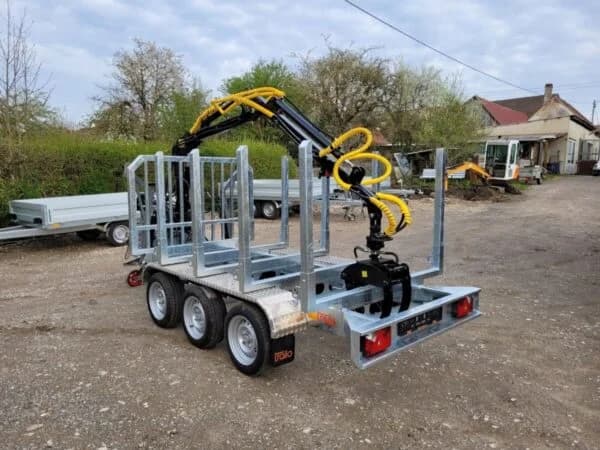
The Fendt HT353017-K forestry trailer is a piece of equipment designed for transporting firewood, logs and branches generally 3 to 4 metres long. It combines a robust trailer with a self-contained hydraulic loading crane, allowing wood to be loaded and unloaded without depending on a tractor or external machine. This configuration is particularly suited to forest owners, farmers, wood heating engineers and green space maintenance professionals who need to handle regular volumes of wood on varied terrain.
Structurally, the trailer is built on a fully welded, hot-dip galvanised chassis. This finish protects the steel against corrosion, which is essential for outdoor use in forests or damp environments. The V-shaped drawbar contributes to the stability of the assembly when towing and makes manoeuvring easier. The side posts, which define the loading area, are designed to be replaceable if damaged: an important point for durability, as these elements are the most exposed to impacts when loading logs. Four sturdy lashing points are distributed on each side, allowing straps or chains to be used to secure the load in accordance with transport regulations.
The trailer's external dimensions are approximately 5.25 m long, 1.63 m wide and 1.70 m high. The loading area between the posts measures approximately 3.00 m long by 1.49 m wide, with a post height of 100 cm. The useful loading volume is approximately 4.5 m³. The gross vehicle weight (GVW) is 3500 kg, with an unladen weight of approximately 1140 kg, leaving a payload of approximately 2360 kg. This capacity allows a significant quantity of wood to be transported, whether logs, roundwood or sawn timber, while complying with the weight limits in force on the road.
The trailer is fitted with three Knott rubber-sprung axles with independent suspension. This type of suspension provides good absorption of uneven terrain and contributes to the stability of the assembly, including on unsurfaced forest tracks. The Knott overrun device is also present, which is a safety feature appreciated when manoeuvring on rough terrain. The tyres are 195/50 R13C, fitted on 13-inch rims. The electrical system is 13-pin, compatible with most recent towing vehicles. The trailer is supplied with the EBE vehicle documents, which facilitates its registration and use on public roads.
The HRW-30 loading crane is the central element of this trailer. It is powered by an integrated hydraulic unit driven by a 6.5 hp 4-stroke petrol engine. This self-contained unit means the crane can operate without being connected to a tractor's hydraulic system, making the trailer usable with a simple car or van fitted with a suitable hitch. The engine is started with a pull starter. The crane offers a 180-degree slewing range, allowing an extended loading zone on either side of the trailer. Its maximum reach is 3.80 m, and its load capacity is 300 kg at 1.5 m reach. The grab has an opening width of 700 mm, sufficient for gripping logs of common diameter. The crane support is hydraulic and unfolds in two stages, with a width of approximately 2800 mm once unfolded, ensuring good stability during lifting operations.
The hydraulic circuit operates at a pressure of 160 bar, with a 9-litre oil tank and a flow rate of approximately 12 l/min. These characteristics are consistent with the needs of a medium-sized wood loading crane. It is important to regularly check the hydraulic oil level and the condition of the hoses, as insufficient pressure or a leak can reduce lifting capacity and damage the pump. The petrol engine must be supplied with suitable fuel (unleaded petrol) and its engine oil level checked before each use. The trailer is delivered fully assembled with all operating fluids, but without fuel; it is therefore advisable to have a can of petrol ready on receipt.
Regarding use, this trailer is designed for transporting wood up to 3-4 m long. It can be hitched to a tractor, quad, van or vehicle with the appropriate licence. In France, the gross vehicle weight (GVW) of 3500 kg means the trailer can be towed with a B licence under certain conditions, but if the trailer's GVW exceeds 750 kg and the gross train weight (GTW) of the combination exceeds 3500 kg, a BE or B96 licence may be required. It is essential to check the regulations in force and the capabilities of the towing vehicle before any use on public roads. In addition, the load must be properly secured and must not exceed the regulatory weight and dimension limits.
For maintenance, the hot-dip galvanising of the chassis and drawbar offers durable protection against rust, but it is recommended to clean the trailer regularly, especially after use in muddy or salty environments. Knott rubber-sprung axles require no particular maintenance, but periodic checks of tyre wear and pressure are advisable. The 195/50 R13C tyres should be inflated to the manufacturer's recommended pressure, generally indicated on the tyre sidewall or in the manual. The 13-pin electrical system should be checked before each journey to ensure that the position, brake, reversing and indicator lights work correctly. The hydraulic crane should be inspected regularly: check for leaks, the condition of the hoses, the hydraulic oil level and the correct operation of the controls. The petrol engine should be serviced according to the manufacturer's recommendations (spark plug, air filter, oil).
When buying a forestry trailer, several points deserve attention. First, the conformity of the GVW and payload with your actual needs: too low a payload will mean more journeys, while too high a GVW may require a specific licence. Next, the quality of the galvanising: a hot-dip galvanised chassis offers better corrosion resistance than a simple paint finish. Also check the brand and model of the axles (here Knott, a reference in the field) and the presence of an overrun device. The crane must be suited to the size of the wood you handle: the 300 kg capacity at 1.5 m is correct for logs of medium diameter, but for heavier wood a more powerful crane may be necessary. Finally, make sure the trailer is supplied with the documents needed for registration (certificate of conformity, user manual) and that the seller offers after-sales service and spare parts.
This Fendt HT353017-K trailer is therefore a versatile tool intended for professional or semi-professional use. It combines a robust structure, a self-contained crane and a loading capacity suited to transporting firewood or logs. Its galvanised chassis and independent suspension axles make it durable equipment capable of operating in difficult conditions. As with any equipment, following the maintenance and safety instructions will guarantee its longevity and reliability.
To go further into maintenance, several areas should be distinguished. The chassis and galvanising: a simple rinse with clean water after periods of work in the forest removes mud and organic residues that retain moisture. A visual inspection of the welds and fixing points is recommended before each season. If a deep scratch cuts into the zinc, a touch-up with zinc-rich paint can prevent rust from appearing. Knott rubber-sprung axles: these axles are known for their robustness, but they are not indestructible. Check the tightening of the fixing bolts, the condition of the rubber bushes and the absence of deformation of the arms. A damaged axle can compromise roadholding and cause premature tyre wear. Tyres: besides pressure, check for uneven wear, which may indicate a tracking or suspension problem. The spare wheel, if present, should be checked regularly. Electrical system: the 13-pin connectors are exposed to the weather; cleaning with a contact product and dielectric protection extend their service life. The rear lights must be watertight; if water gets in, oxidation can cause failures. Hydraulic crane: the hydraulic oil should be changed according to the manufacturer's recommendations, generally every 500 to 1000 hours of use. The hydraulic oil filter, if present, should be replaced. The hoses should be inspected for cracks, bulges or leaks; a hose that bursts under pressure can be dangerous. The fittings should be tightened to the recommended torques. Petrol engine: engine oil change, spark plug replacement, air filter cleaning or replacement, oil level and fuel filter checks. The pull starter should be handled carefully to avoid premature wear of the mechanism. The grab: the jaws should be greased at the pivot points and checked for wear. Excessive play reduces grip and can damage logs.
Regarding transport regulations in France, several rules apply. The GVW of 3500 kg places this trailer in the category of trailers whose gross vehicle weight exceeds 750 kg. To tow it, a B licence is sufficient if the GTW of the combination (towing vehicle + trailer) does not exceed 3500 kg. If the GTW exceeds 3500 kg without exceeding 4250 kg, the B96 licence is required. Above 4250 kg, the BE licence is mandatory. It is therefore essential to check the GTW of the towing vehicle, stated on the registration certificate (box F2 or F3). In addition, the trailer must be registered, insured and fitted with a compliant coupling device. The load must not extend more than 3 metres beyond the rear (or 1 metre if the trailer is hitched to a vehicle of less than 3.5 tonnes), and must be marked with a reflective device if necessary. The width of the load must not exceed 2.55 metres. The drawbar load must be respected according to the towing vehicle manufacturer's recommendations. Finally, the transport of wood may be subject to local or environmental regulations, particularly regarding protected species or forest areas.
Sector-specific use cases are varied. For a private individual heating with wood, this trailer allows logs or roundwood to be collected from the forest and transported to the storage location. The self-contained crane avoids having to hire a lifting machine or ask for help. For a farmer, it usefully complements a fleet of equipment by allowing the transport of hedge wood, branches after pruning, or firewood for the farm. For a tree surgeon, it offers a solution for collecting and removing woody green waste, with the possibility of loading cut sections directly. For a forestry contractor, it can serve as an auxiliary trailer for transporting small lots or for accessing difficult plots where a truck cannot go. For a heating engineer, it allows firewood to be delivered in small quantities to private customers, with quick loading and unloading thanks to the crane. Finally, for an equipment rental company, this type of trailer is an attractive offering for private individuals and professionals.
Compared with other sizes and types of forestry trailers, the HT353017-K sits in the medium-sized trailer segment. Smaller models, often single-axle and without a crane, have a reduced payload and require manual loading. They are suited to small volumes and short distances. Larger models, with two axles and a more powerful crane, offer a higher payload and longer reach, but they are heavier, bulkier and require a more powerful towing vehicle. The HT353017-K strikes a balance: it is compact enough to be towed by a van or a low-power tractor, while offering a payload of more than 2 tonnes and a crane capable of handling medium-sized logs. Compared with a trailer without a crane, it eliminates the need to load manually or with an external machine, which reduces physical strain and working time. Compared with a trailer with a tractor-powered crane, it offers the advantage of autonomy, but requires an additional petrol engine to maintain. The choice will therefore depend on the main use: for regular jobs with a tractor available, a power take-off driven crane may be more economical in use; for occasional use with various vehicles, autonomy is a major asset.
In conclusion, the Fendt HT353017-K trailer with HRW-30 crane is a considered investment for anyone who needs to transport and handle wood regularly. Its robust design, quality equipment and versatility make it a reliable tool. However, you should carefully assess your needs in terms of volume, weight and frequency of use, and check compatibility with the towing vehicle and the licences required. Rigorous maintenance and use in accordance with safety instructions will guarantee years of service.