Description
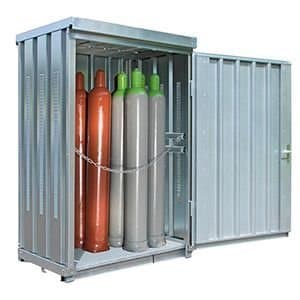
The UJH556K gas cylinder storage container is a professional solution for the safe and regulatory storage of compressed or liquefied gas cylinders. This model is a galvanized metal container with a grid floor, specially designed to hold up to 14 x 50L cylinders. Its overall dimensions are 1420 mm long, 1080 mm wide and 2250 mm high. It is delivered assembled, ready for on-site installation after anchoring.
This container is built in accordance with TRGS 510 technical rules for the storage of hazardous materials. The side wall, roof and door panels are made of Sendzimir galvanized trapezoidal sheets, offering corrosion resistance suitable for outdoor use. The standard door is equipped with a security lock with push-button assembly and is supplied with three keys. The construction has a structural analysis verified according to DIN EN 1990 + NA 2010, DIN EN 1991 Parts 1-1, 1-3, 1-4 + NA 2010 and DIN EN 1993 Parts 1-1, 1-3, 1-8 + NA 2010. This guarantees the mechanical strength of the assembly, with permissible wind loads of 0.58 kN/m² (wind load zone 2) and a roof load (snow) of 220 kg/m².
The cylinder retention device is adjustable according to cylinder type and supplemented by additional safety chains. The entire unit is fully galvanized, ensuring durable weather protection. Permanent constructive internal ventilation is integrated to comply with the air renewal prescribed by TRGS 510. According to TÜV Rheinland assessment, this gas store can be used as an "outdoor warehouse" in accordance with TRGS 510, point 2. It combines the advantages of a closed storage system with those of a metal lattice structure, while complying with point 7.2.7 of TRGS 510 regarding the prohibition of collective storage.
This container is intended for professionals and individuals wishing to store gas cylinders outdoors under optimal safety conditions. It can be used on construction sites, in craft businesses, service stations, gas depots, or industrial sites. Its design protects cylinders against weather, impacts and unauthorized access, while ensuring permanent ventilation to prevent gas accumulation in case of leakage.
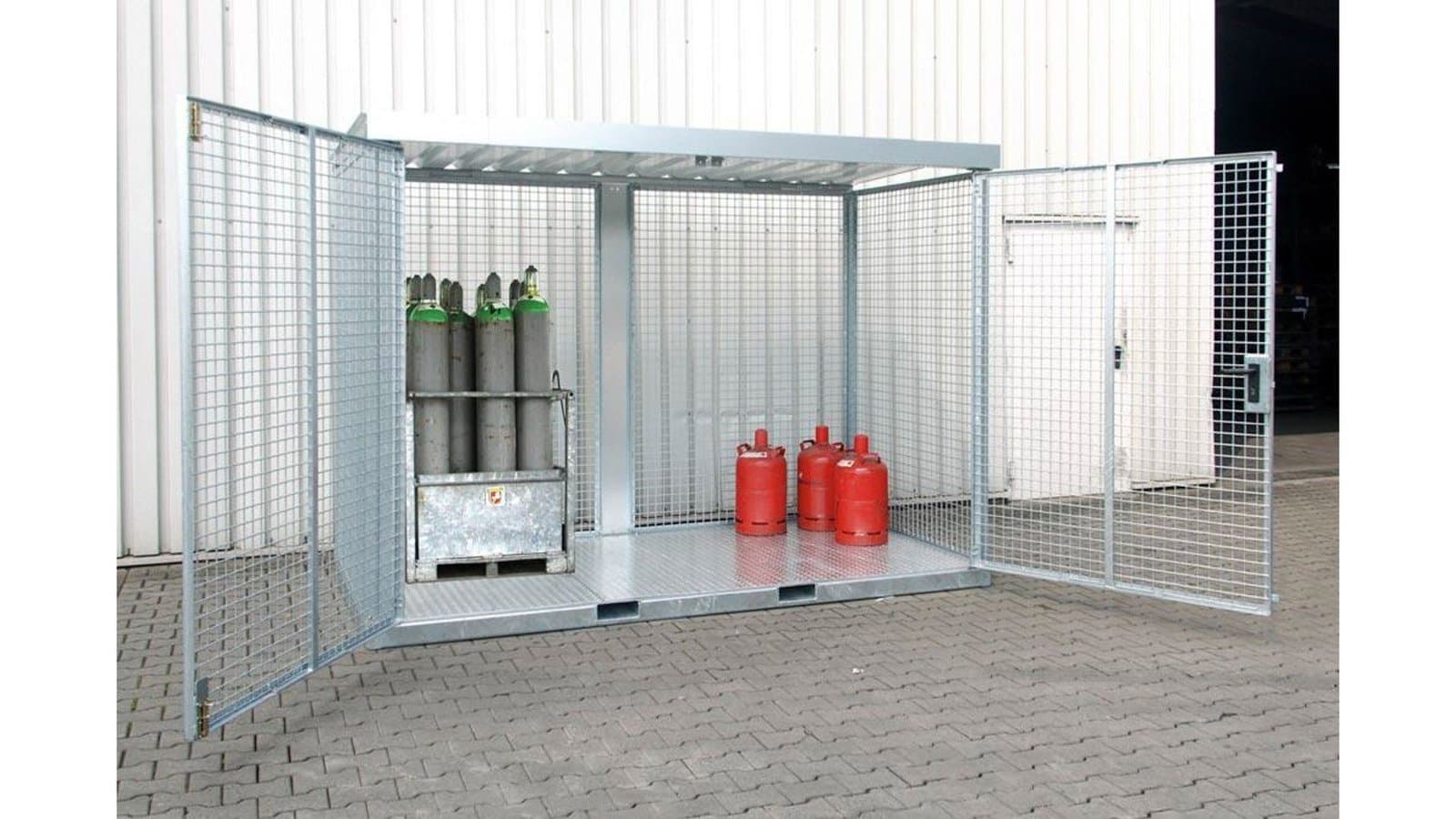
The capacity of 14 x 50L cylinders meets the common storage needs for propane, butane, acetylene, oxygen, nitrogen, argon or CO2. The grid floor allows liquid drainage and prevents water retention, which is particularly important for liquefied gas cylinders. Hot-dip galvanizing ensures corrosion resistance even in marine or industrial environments.
Installation requires anchoring to the ground, as provided for in the design. It is recommended to check the ground conditions and use suitable fasteners. The container can be moved using a forklift or crane, thanks to its reinforced structure, but it is advisable to consult a professional for lifting. Once installed, it must be kept upright and stable.
Maintenance is minimal: regular visual inspection of the galvanizing, hinges, lock and safety chains is sufficient. If the galvanizing is damaged, a touch-up with zinc-rich paint can be applied. It is important to keep ventilation clear and not obstruct the grilles. Periodic cleaning with clean water removes deposits that may retain moisture.
Points to check when purchasing: verify that the container complies with local regulations in force for gas storage. In France, regulations on gas cylinder storage are governed by the Environmental Code and prefectural decrees. It is essential to consult the competent authorities to validate the location and quantities stored. This container is designed according to German standards (TRGS 510, DIN), but its use in France must comply with French texts, particularly regarding safety distances, authorized volumes and declaration obligations. The buyer must ensure that the installation complies with local planning regulations and fire safety rules.
This container is not a standard shipping container: it is specific gas storage equipment. It must not be confused with a dry, reefer, open top or flat rack container. Its structure is optimized for ventilation and cylinder retention, not for general cargo transport. It can be used as a site office or technical room after fitting out, but this is not its primary function and would require modifications.
The construction in Sendzimir galvanized trapezoidal sheets offers good rigidity and impact resistance. The roof supports a snow load of 220 kg/m², allowing installation in regions subject to moderate snowfall. The wind resistance of 0.58 kN/m² corresponds to wind zone 2 according to European standards, covering a large part of France. For more exposed areas, additional checks may be necessary.
The adjustable retention device with safety chains keeps cylinders upright even if the container moves. The additional chains provide redundant safety. The door with security lock and push-button assembly limits the risk of break-in. Three keys are supplied, but the cylinder can be replaced for centralized access management.
In summary, this gas cylinder storage container is a robust solution, compliant with German safety requirements, which can be adapted for use in France subject to local regulations. It offers a capacity of 14 x 50L cylinders, permanent ventilation, weather protection and access security. Its price of 2000 EUR excl. VAT is competitive for equipment of this size and quality. For any questions on installation or compliance, it is recommended to consult a gas professional or an inspection body.
To complete this presentation, routine maintenance and periodic checks should be addressed in more detail. A gas storage container installed outdoors is exposed to dust, dead leaves, snow and atmospheric pollution. It is therefore advisable to clean it at least twice a year, ideally in spring and autumn, to clear the ventilation grilles and the grid floor. A low-pressure water jet is sufficient; the use of a high-pressure cleaner should be avoided as it could damage the galvanizing layer or displace seals. After cleaning, a visual check of welds and fastening points detects any early corrosion. If traces of white rust (zinc oxide) appear, they are generally superficial and can be removed with a soft brush. Red rust, however, indicates damage to the steel substrate: local sanding and application of zinc-rich paint are then required to restore protection. Door hinges, lock and push mechanism should be lubricated once or twice a year with water-resistant grease, such as lithium grease, to avoid stiff points and premature wear. Safety chains must be inspected: deformed links, excessive corrosion or worn attachments require replacement. Finally, it is recommended to check the ground anchor after strong winds or freeze-thaw cycles, as ground movement can loosen fasteners.
Regarding transport regulations, this container is not intended to be transported on public roads as a vehicle or trailer. It is fixed or movable equipment, but its road transport must comply with loading and securing rules. In France, the transport of gas cylinders is subject to ADR (European Agreement concerning the International Carriage of Dangerous Goods by Road). When transported loaded with cylinders, the assembly must be considered a dangerous goods load and comply with ADR requirements: vehicle marking, transport documents, driver training, and compliant securing. For empty transport, the container itself is not dangerous goods, but it remains subject to general rules for transporting indivisible or heavy loads: dimensions, weight, marking and possible permits. As the empty weight is not provided, it is essential to know it before any transport to respect vehicle load limits. Transport by container truck or flatbed is recommended, with straps and chocks. The container does not have ISO corner fittings like a standard shipping container; lifting must be done with suitable slings or a forklift, taking care not to deform the panels. It is prohibited to lift the container by the roof or doors.
Sector-specific use cases are varied. In construction, this container stores oxygen and acetylene cylinders used for welding and cutting, or propane cylinders for site heating. It prevents cylinders from being exposed to weather and theft, while complying with safety distances from work areas. In manufacturing, it stores argon, CO2 or MIG/MAG welding mixture cylinders, as well as nitrogen cylinders for inerting. Mechanical workshops and body shops find a solution for oxygen and acetylene cylinders. In agriculture, propane cylinders for greenhouse heating, grain drying or forklift power can be grouped in this container. Vineyards also use CO2 cylinders for tank inerting. In leisure and events, gas cylinders for marquees, food trucks or temporary installations can be stored securely. Service stations and self-service gas cylinder depots use this type of container for buffer storage. Finally, local authorities and municipal technical services store gas cylinders for green space maintenance, public building heating or emergency generators.
Let us now compare this container with other sizes and types of storage solutions. There are smaller gas storage containers, for example for 6 or 8 cylinders, suitable for small workshops or occasional needs. Conversely, larger models can hold 20, 30 or 40 cylinders or more, intended for large depots or industrial sites. The choice depends on gas consumption volume, replenishment frequency and available space. The 14 x 50L model offers a good compromise: it stores the equivalent of several weeks' consumption for a medium workshop, while remaining compact (less than 1.5 m long) and maneuverable. By comparison, a standard 20-foot shipping container (about 6 m long) offers much greater volume, but it is not designed for permanent ventilation or cylinder retention; its use for gas storage would require specific modifications and regulatory compliance that is difficult to obtain. Dry shipping containers are generally made of Corten steel, more corrosion-resistant than ordinary steel, but their ventilation is nil or limited to air vents, which is insufficient for gas storage. Reefer containers are equipped with a refrigeration unit and are not suitable. Open top and flat rack containers are not closed and offer no protection against weather or access. High cube containers have a greater height (2.89 m) but are not suitable for gas storage without modifications. Finally, gas storage cabinets, which are smaller, are often made of painted steel sheet and not galvanized; they are suitable for one or two cylinders, but not for a capacity of 14. This container stands out for its full galvanizing, constructive ventilation and TRGS 510 compliance, making it a turnkey solution for professionals.
It is also useful to specify the limits of use. This container is designed for outdoor storage, but it can be placed under a canopy to limit snow accumulation on the roof. It must not be installed in a closed room without ventilation, as the internal ventilation must be able to discharge to the outside. It must not be buried or placed in a pit, as gases heavier than air (propane, butane) could accumulate there. It is recommended to install it on a flat, stable surface, preferably a concrete slab or compacted ground, and at a sufficient distance from buildings, emergency exits, air vents and ignition sources. Minimum distances depend on local regulations and the volume stored; in France, the decree of 23 August 2005 on general requirements applicable to installations classified for environmental protection subject to declaration under heading 1412 (storage of flammable gases) sets rules, but other texts may apply. It is therefore imperative to check with the prefecture or an inspection body. Finally, this container must not be used to store damaged or leaking cylinders; any leak must be dealt with immediately and the cylinders concerned isolated.
For purchase, it is advisable to check that all accessories are present: chains, retention device, keys, and possibly anchoring fasteners. A certificate of conformity or technical documentation can be requested from the supplier. The price of 2000 EUR excl. VAT is an indicator, but delivery costs, anchoring and any permits must be taken into account. The durability of Sendzimir galvanizing is generally several decades outdoors, depending on the environment. In coastal or industrial areas, more frequent inspection is recommended. This container can be painted if a specific color is desired, but the paint must be compatible with galvanizing (epoxy or polyurethane paint after degreasing and suitable primer).
In conclusion, the UJH556K gas cylinder storage container is professional equipment combining safety, durability and compliance with German standards. It meets the needs of many sectors and can be integrated into a risk management approach. Its use in France requires regulatory vigilance, but it provides a solid basis for outdoor gas cylinder storage. For any technical or regulatory questions, it is recommended to consult a qualified professional.