Description
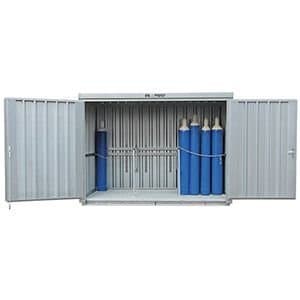
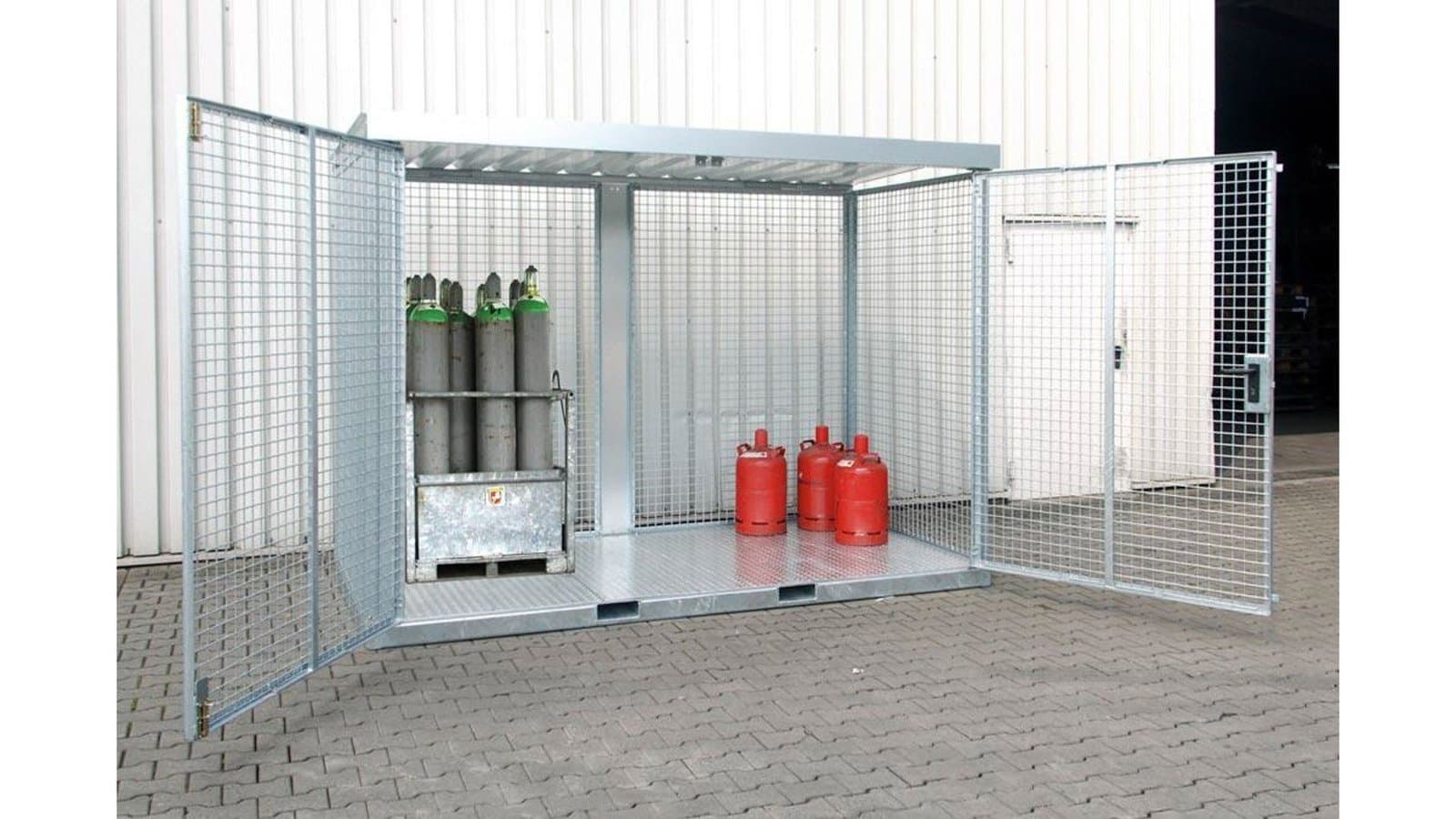
Storing gas cylinders is a regulated activity, as cylinders contain pressurized gases that are often flammable or toxic. In Germany, TRGS 510 (Technische Regeln für Gefahrstoffe) sets the rules for storing compressed, liquefied and dissolved gases. In France, the applicable regulations depend on the type of gas and quantities stored, but they rely on similar principles: separation of areas, ventilation, signage, protection against impacts and ignition sources. The fitted shipping container we offer here meets these requirements by providing a dedicated, identifiable and ventilated enclosure, without having to build a permanent structure.
This container is based on a 10-foot ISO structure in Corten steel. Corten steel is a low-alloy steel that resists atmospheric corrosion through the formation of a protective oxide layer on the surface. It has been used to manufacture shipping containers for decades, ensuring a long service life even outdoors. The structure includes standardized corner castings (ISO 668), allowing the container to be lifted, moved and secured with standard equipment (spreader, forklift, slings). The floor is made of 28 mm marine plywood, often covered with an anti-slip coating or checkered plate to improve safety. The side walls, door and roof are made of corrugated steel sheet, providing good rigidity and impact resistance.
The specific fit-out for gas cylinder storage includes several elements. First, permanent natural ventilation, usually provided by grilles or vents at the bottom and top, to allow the evacuation of gases heavier than air (such as propane or butane) and prevent any accumulation. Second, supports or racks can be installed to hold cylinders upright and prevent them from falling. The door is fitted with a locking system to restrict access to authorized personnel. Standardized signage (hazard pictograms, gas labels, no-smoking signs) is affixed to the walls and door. Finally, the container can be equipped with explosion-proof interior lighting, a gas detector and a fire extinguisher, depending on site requirements.
The dimensions of a 10-foot container are standardized: overall length of approximately 2,991 mm, width 2,438 mm, height 2,591 mm (or 2,438 mm for a non-high cube model). Tare weight is generally between 1,200 and 1,400 kg, and payload can reach several tonnes, depending on the design. These reduced dimensions allow it to be installed in confined spaces, while offering an internal volume of approximately 15 m³. For gas cylinder storage, 10- or 20-foot containers are often preferred, as they are easier to ventilate and divide into zones.
Using a shipping container for gas cylinder storage offers several advantages. It is mobile: it can be moved on site or from one site to another with a truck or forklift. It is robust: the steel structure resists weather, impacts and vandalism. It is modular: it can be combined with other containers to create a larger depot, or fitted with thermal insulation to limit temperature variations. Finally, it complies with ISO standards, which facilitates its transport by sea, rail or road.
However, purchasing a container for gas storage requires some points of vigilance. First, check the container's compliance with local regulations: in France, gas cylinder storage is subject to ICPE regulations (Installations Classées pour la Protection de l'Environnement) depending on the quantities and nature of the gases. It is recommended to consult a inspection body or engineering firm to validate the layout and equipment. Second, ensure that ventilation is sufficient and correctly sized: ventilation tests may be necessary. Signage must comply with current standards (NF X 08-003 for pictograms, for example). Finally, regular maintenance is essential: checking the condition of paint, seals, locks, ventilation grilles, and inspecting the cylinders themselves (test date, valve condition).
Regarding container maintenance, a few simple operations extend its service life. Periodic washing with clean water and neutral soap removes salt deposits or pollutants. Deep scratches should be treated with anti-rust paint to prevent corrosion. Hinges and locks should be lubricated. The floor should be inspected for worn or rotten areas; partial replacement is possible. If the container is insulated, check for moisture in the walls. Finally, it is advisable to raise the container on blocks or beams to avoid direct contact with the ground and promote water drainage.
Transporting a 10-foot container is relatively simple. It can be loaded onto a container truck, flatbed or trailer. The corner castings allow secure lashing. For long distances, sea or rail transport is possible, but handling surcharges must be taken into account. In France, road transport of containers is subject to weight and dimension regulations (maximum width 2.55 m, maximum height 4 m, maximum length 16.5 m for a road train). A 10-foot container falls within these limits. If the container is loaded with gas cylinders, transport must comply with ADR (European Agreement concerning the International Carriage of Dangerous Goods by Road), which requires specific documents, marking and safety equipment.
In summary, this TRGS 510 gas cylinder storage container is a practical, robust and mobile solution for professionals who need to store gas cylinders in a dedicated and secure space. It combines the strength of a shipping container with a fit-out compliant with ventilation, signage and safety requirements. It can be used on a construction site, in a factory, a logistics depot, a laboratory or an event site. Before purchase, it is essential to check the regulations applicable to your situation and to correctly size the container according to the quantities and types of gases stored. A well-maintained container can serve for many years, making it a durable investment.
To go further, it is useful to detail sector-specific use cases. In the building and public works sector, gas cylinders (oxygen, acetylene, propane) are used for welding, heating, cutting or powering generators. A dedicated storage container groups these cylinders at a single point, away from risky work areas, and protects them from impacts and theft. On a construction site, the container can be moved as work progresses, avoiding the multiplication of unregulated storage areas. In manufacturing, gas cylinders are used for welding, cutting, heat treatment or laboratory processes. A ventilated and signposted container ensures compliance with safety instructions while keeping cylinders close to workstations. In the agri-food sector, carbon dioxide is used for preservation, carbonation or modified atmosphere packaging; a dedicated container prevents cross-contamination and facilitates stock management. In the medical and laboratory sector, oxygen, nitrogen or helium cylinders are stored; a container isolates them from sensitive areas and controls access. Finally, in events, gas cylinders supply kitchens, heaters or generators; a mobile container is particularly suitable as it can be installed and removed quickly.
Now let's compare different container sizes for gas storage. The 10-foot container, the subject of this sheet, offers a good compromise between compactness and capacity. It can hold a limited number of cylinders, generally from a few units to a few dozen depending on their size and layout. The 20-foot container offers an internal volume of approximately 33 m³, more than double. It allows storing a larger number of cylinders, but it is bulkier and heavier to move. The 40-foot container, with approximately 67 m³, is rarely used for gas storage because it is difficult to ventilate evenly and requires many cylinders to fill. The high cube container (9 feet 6 inches high, i.e. 2,896 mm) offers additional height that can facilitate vertical storage or the installation of stacked racks. The open top container, with an opening roof, can be useful for loading tall cylinders or installing zenithal ventilation, but it is less rain-tight. The flat rack container, without side walls, is not suitable for gas storage as it offers no containment. Finally, the reefer container (refrigerated) is designed for transporting perishable goods; it can be repurposed for gas storage, but its cooling system is unnecessary and its ventilation is often insufficient for heavy gases. The standard dry container therefore remains the most relevant choice, with a specific fit-out.
Let's examine in more detail the French regulations applicable to gas cylinder storage. In France, gas storage facilities are classified according to the ICPE nomenclature (Installations Classées pour la Protection de l'Environnement). Heading 4718 covers liquefied flammable gases (propane, butane) and heading 4725 covers toxic gases. Declaration and authorization thresholds vary depending on the nature of the gas and quantities. For example, for propane, declaration is required from 6 tonnes, and authorization from 50 tonnes. For oxygen, the regulations differ as it is an oxidizer. It is therefore essential to refer to the current nomenclature and consult the DREAL (Direction Régionale de l'Environnement, de l'Aménagement et du Logement) to know the exact obligations. In addition to ICPE, fire safety rules must be respected, particularly those of the fire safety regulations (decree of 25 June 1980 for public buildings, or insurers' requirements). Ventilation must be sufficient to prevent any gas accumulation, and electrical equipment must comply with ATEX zones (explosive atmospheres) if flammable gases are stored. Signage must comply with NF X 08-003, with clearly visible hazard pictograms. Finally, the cylinders themselves must be maintained and checked periodically (ten-year test, valve inspection, etc.).
For transport, ADR classifies gases into several categories: flammable gases (class 2.1), non-flammable non-toxic gases (class 2.2), toxic gases (class 2.3). Transporting gas cylinders is subject to strict rules: transport documents, package marking, protective equipment, driver training, etc. A storage container can be used as a transport unit, but it must then meet ADR requirements for containers (particularly in terms of strength and marking). It is advisable to use a specialized carrier for this type of goods.
Finally, routine container maintenance deserves detail. Regular visual inspection detects signs of corrosion, cracks, deformation or leaks. Ventilation grilles must be cleaned to prevent obstruction by leaves, dust or insect nests. Door seals must be checked and replaced if necessary to ensure water tightness. Paint must be maintained: annual cleaning and touching up scratches is usually sufficient. The floor must be checked: if boards are rotten, they must be replaced. Locks and hinges must be lubricated. If the container is equipped with lighting or a gas detector, their operation must be checked and batteries or bulbs replaced. Finally, it is recommended to keep a maintenance and inspection log, which may be required by authorities or insurers.
In conclusion, this TRGS 510 gas cylinder storage container is a complete, durable solution compliant with applicable safety principles. It is intended for professionals who want a dedicated, mobile and robust storage area without building a permanent structure. Before purchase, the container should be sized according to the quantities and types of gases, local regulations checked, and additional equipment (ventilation, detection, lighting) planned. A well-maintained container can serve for many years, making it a profitable and secure investment.


 Promo