Description
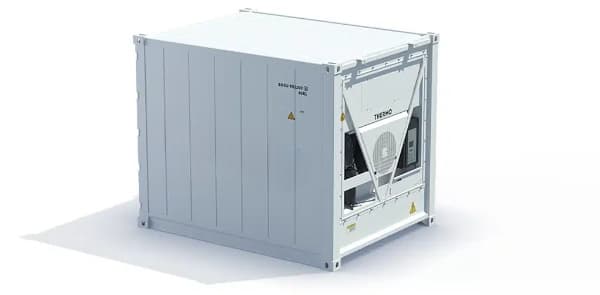
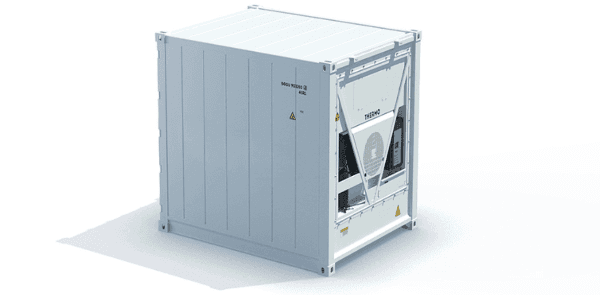
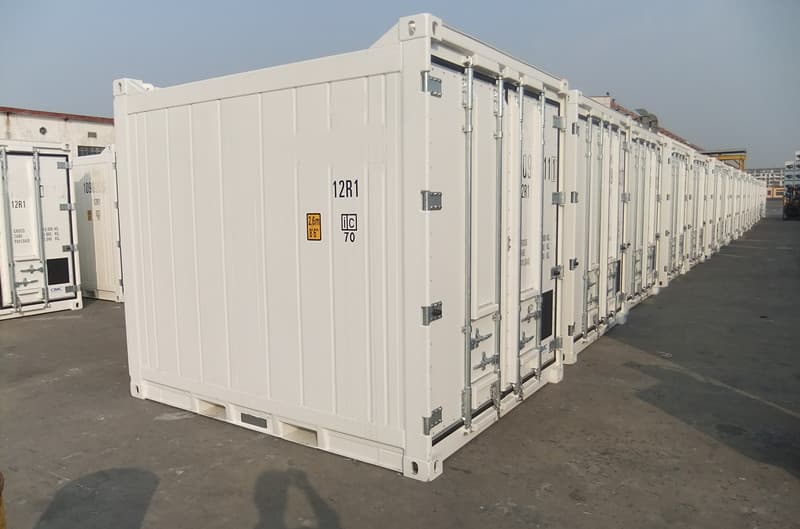
The 10ft refrigerated container, also called a reefer, is a self-contained refrigeration unit designed for transporting and storing temperature-sensitive goods. Its compact size — about 3 metres long — makes it suitable for sites where space is limited: urban yards, construction sites, event car parks, restaurant back areas or small logistics platforms. Unlike standard dry containers, it includes a refrigeration unit and reinforced insulation that maintain a controlled temperature, from freezing to positive preservation.
This 10ft model stands out from 20ft and 40ft formats by its smaller footprint. With an overall length of about 2.99 m, a width of 2.44 m and a height of 2.59 m, it can be installed in locations where a 20ft would not fit. Its empty weight of about 2,600 kg remains compatible with most delivery trucks and standard-capacity forklifts. This compactness does not sacrifice its primary function: keeping cold.
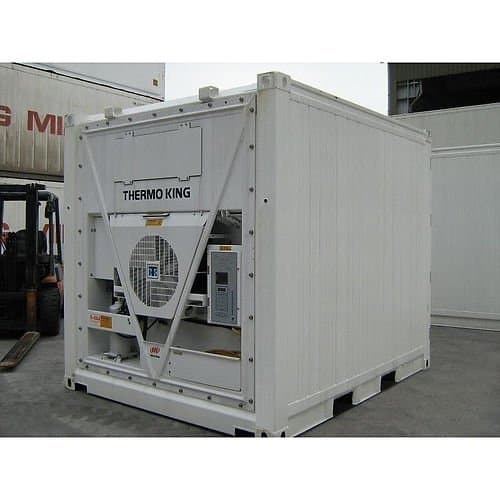
The reefer principle relies on an insulated envelope and a refrigeration unit. The walls, ceiling and floor are made of sandwich panels with an insulating core (usually high-density polyurethane foam) sandwiched between two metal sheets. This design limits heat loss and reduces the load on the unit. The refrigeration unit, mounted on the front, produces cold and circulates air inside the chamber via evaporators and fans. Electronic control allows selecting a temperature setpoint and maintaining it automatically, with a usual range of -25°C to +25°C depending on the model. This range covers both freezing food products and preserving perishables, pharmaceuticals or cut flowers.
The refrigeration unit is powered by an electrical connection. Depending on the model, it operates on 380V three-phase or 220V single-phase. It is essential to check the compatibility of the host site's electrical installation with the unit's specifications: available power, plug type, residual current protection and earthing. A reefer does not produce cold without power; it is not a storage system. In case of a power cut, the temperature rises gradually, faster or slower depending on insulation and outside temperature. For very sensitive goods, a backup power supply or generator may be considered.
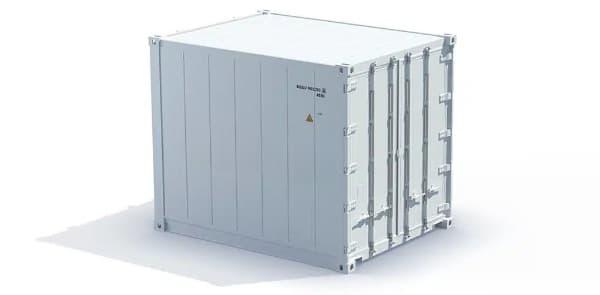
The container structure uses materials proven in the maritime sector. The frame and external walls are generally made of Corten steel, a low-alloy steel with higher atmospheric corrosion resistance than ordinary steel. This choice is particularly relevant for equipment intended to remain outdoors, exposed to moisture and sea spray, especially in coastal areas. The floor is made of marine plywood, often 28 mm thick, suitable for rolling loads and damp environments. The rear doors are double doors fitted with standard container locks, with seals that contribute to thermal performance. These seals must be kept in good condition: a crushed or torn seal lets warm air in and increases the unit's consumption.
ISO compliance is an important point. Maritime containers, including reefers, meet international standards that define their dimensions, corner fittings and handling characteristics. ISO 668 covers the dimensions and masses of series 1 containers, while ISO 1496-2 deals specifically with refrigerated containers, particularly regarding insulation and thermal performance. This standardisation ensures that a 10ft container can be handled with standard equipment (spreader, forklift, hooks) and stacked according to the rules. It also facilitates intermodal transport: road, rail, sea. However, not all models are necessarily stackable in all configurations; the manufacturer's requirements and the condition of the structures should be checked before any stacking.
The internal volume of a 10ft reefer is about 12 m³, offering significant storage capacity for a small footprint. As a guide, this corresponds to several European pallets or a large volume of boxes, crates or packaged pharmaceuticals. The payload depends on the empty weight and the maximum permitted load, usually indicated on the container plate. It is recommended not to exceed this limit and to distribute loads evenly on the floor to avoid damaging the structure or compromising air circulation.
Air circulation is an often overlooked aspect. In a reefer, cold is distributed by forced convection: air passes through the evaporator, is cooled, then blown into the chamber. For this system to work properly, avoid blocking the return and supply grilles, and do not place goods against the walls. A minimum spacing allows air to circulate around the products and equalise the temperature. For pallets, using spacers or open-bottom pallets improves circulation. Too compact a load creates hot spots and can make the temperature vary beyond the setpoint.
The use of a 10ft refrigerated container covers several areas. In food, it allows storing fresh produce, meat, dairy, fruit and vegetables or frozen goods, whether for catering, distribution or production. In the medical and pharmaceutical sector, it can be used to store products requiring a cold chain, subject to applicable regulatory requirements and temperature recording if necessary. For events, it serves as a mobile cold room for caterers, festivals or markets. In industry, it can hold chemicals or heat-sensitive materials, after checking compatibility and safety rules. Finally, it can be used as a refrigerated technical room on a construction site or logistics base.
Installing a reefer requires some precautions. The ground must be stable and level to avoid stress on the structure and unit. A slight excavation or blocks can improve stability and drainage. The container must be accessible for unit maintenance, with sufficient clearance in front. The power supply must be protected and comply with current standards. Outdoors, it is advisable to provide protection from direct sunlight, such as a roof or shaded area, to reduce heat load and consumption. Regular unit maintenance (cleaning exchangers, checking filters, checking pressures, checking seals) extends its life and maintains performance.
Routine maintenance of a reefer container includes several simple operations. Periodically check the condition of door seals and replace if necessary. Evaporators and condensers must be cleaned to avoid fouling that reduces efficiency and increases consumption. The refrigeration circuit must be checked by a qualified professional, as refrigerants are subject to regulations. Condensate drains must be kept clear to avoid water accumulation. Finally, a visual check of the structure (rust, impacts, deformation) helps detect problems before they worsen.
When buying a used refrigerated container, several points deserve attention. The condition of the refrigeration unit is decisive: a unit at the end of its life can be costly to replace. It is useful to request a running test and, if possible, a temperature record over several hours. The condition of the interior walls and floor should be examined: perforating rust, delamination, persistent odours or traces of moisture. The doors must close properly and the seals must be flexible. The container plate (CSC, capacity, tare) must be legible and up to date. Finally, ISO compliance and the container's traceability are quality guarantees.
Transporting a 10ft container in France and Europe follows specific rules. On the road, it is generally carried on a container truck or suitable trailer. The total weight (tare plus load) must not exceed the limits allowed by the highway code and heavy goods vehicle regulations. The width of 2.44 m corresponds to the standard width of an ISO container and remains compatible with most routes, subject to checking local restrictions (bridge heights, road widths, traffic bans). For deliveries requiring a crane or high-capacity forklift, a permit may be required. It is recommended to prepare the location and check access before delivery.
From a regulatory perspective, the use of a refrigerated container may be subject to requirements depending on the activity. For storing animal or animal-origin food, hygiene and approval rules may apply. For pharmaceuticals, the cold chain is regulated and may require temperature recorders and validated procedures. For the electrical installation, the connection must be made properly, with suitable protection. Finally, installing a container on a plot may fall under local planning rules; it is prudent to check with the town hall or relevant department.
The 10ft refrigerated container has several advantages over other cooling solutions. It is mobile: it can be moved from one site to another with appropriate handling equipment. It is self-contained once connected to the power grid, without requiring a heavy technical room. It is robust and designed for outdoor use. It offers efficient insulation and precise regulation. In return, it requires a power supply, regular maintenance and vigilance on the cold chain in case of a power cut. Its internal volume, although compact, remains usable for many applications.
Compared to a 20ft reefer container, the 10ft is easier to install in urban areas and less bulky. It generally consumes less than a larger model, with equivalent insulation, because the volume to cool is smaller. However, it offers less storage capacity. The choice therefore depends on the volume of goods to handle, rotation frequency and available space. For small regular volumes or occasional needs, the 10ft is often relevant. For large volumes, a 20ft may be more economical in use.
When buying, it is advisable to define the need precisely: minimum and maximum required temperature, storage duration, type of products, door opening frequency, access and power constraints. These elements help choose the right model and size the installation correctly. A new container offers the advantage of good insulation and unit condition, with potentially long life. A used container can be an economical alternative, provided its condition and performance are checked. In all cases, it is recommended to request precise information on origin, unit age and any repairs.
To further compare with other formats, the 10ft reefer should be distinguished from the 10ft dry. The dry has neither a refrigeration unit nor reinforced insulation: it protects from rain, wind and theft, but not from heat or frost. The reefer adds active regulation. The extra purchase and operating cost is justified as soon as the goods require a stable temperature. Compared to the 20ft high cube reefer, the 10ft offers lower internal height and about half the volume. The high cube, with its extra height, allows loading taller pallets and optimising volume, but it is bulkier and heavier. The 40ft reefer is intended for large volumes and regular flows; it is less suited to constrained sites. Finally, open top and flat rack containers, without rigid walls or roof, are not suitable for cold: they are designed for out-of-gauge loads. Choosing a 10ft reefer therefore corresponds to a specific need: moderate volume, controlled temperature and minimal footprint.
Sector-wise, several use cases deserve detail. In catering and bakery-pastry, a 10ft reefer can serve as an auxiliary cold room for storing raw materials, finished products or preparations, especially during peak periods. In local retail or markets, it keeps food safe and cool during the sales day. In the flower sector, it helps maintain a cool temperature that prolongs bouquet life. In the medical field, analysis laboratories or pharmacies can store reagents and temperature-sensitive products, subject to good practices and regulations. In the agri-food industry, it can serve as a buffer between production and shipping. For events, caterers and organisers find a mobile solution for buffets, drinks and prepared dishes. Finally, in construction, it can hold materials sensitive to moisture or heat, such as certain glues, resins or paints.
Another practical aspect concerns temperature management when doors are opened. Each opening lets ambient air in and raises the internal temperature. To limit this effect, it is advisable to group withdrawals, close doors quickly and use a strip curtain if possible. In very hot environments, the temperature difference between inside and outside can be significant; the unit must then work harder. Pre-cooling goods before loading reduces the heat load and improves stability. Never load hot products into an already cold reefer: this would raise the temperature and unnecessarily strain the unit.
The question of humidity also deserves attention. Cold condenses water in the air. Reefers are equipped with drains to remove condensate. If these drains become blocked, water can accumulate on the floor and damage the floor or goods. Regular checking of drainage is therefore useful. For some products, too low humidity can cause drying out; in this case, humidification systems may be considered, but they are not standard on all models. It is advisable to check the exact specifications of the installed unit.
Finally, temperature monitoring is a key point for professional uses. Many refrigeration units include a recorder or data output for tracing history. For activities subject to the cold chain, this monitoring may be required. It is recommended to check the presence of this function and ensure it is operational. If in doubt, an independent recording thermometer can be added inside the container. This precaution helps detect deviations and react quickly.
In summary, the 10ft refrigerated container is a versatile tool for cold preservation. Its compactness, ISO compliance and wide temperature range make it suitable for many professional uses. Properly installed and maintained, it can provide long service, whether for storing, transporting or displaying temperature-sensitive products. For any questions about this model, its availability or accessories, you can contact D.S. Globe Conteneur in Marseille, who can specify the exact characteristics of the product offered and available options.