Description
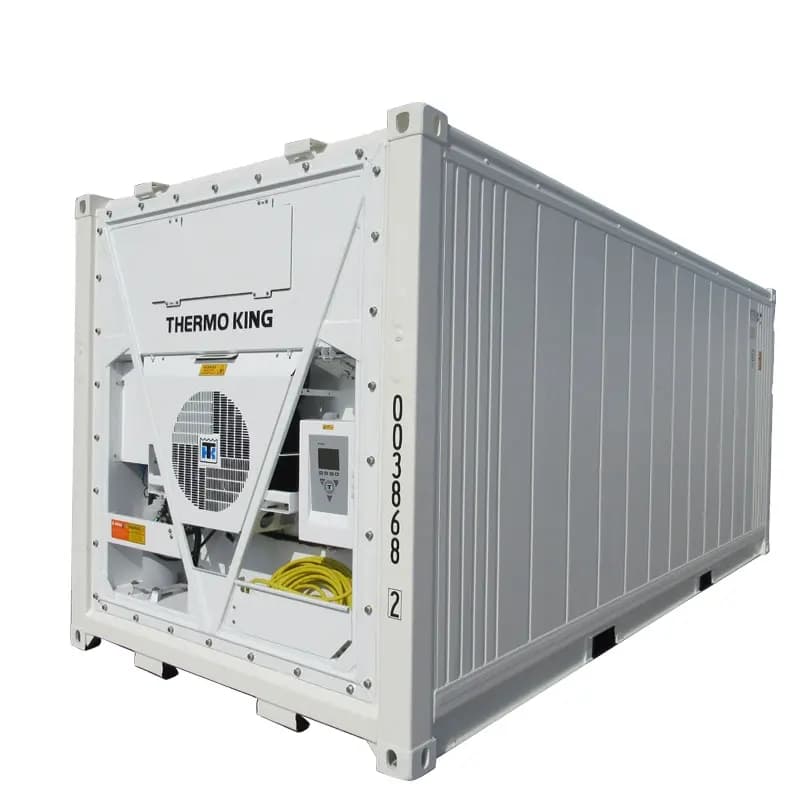
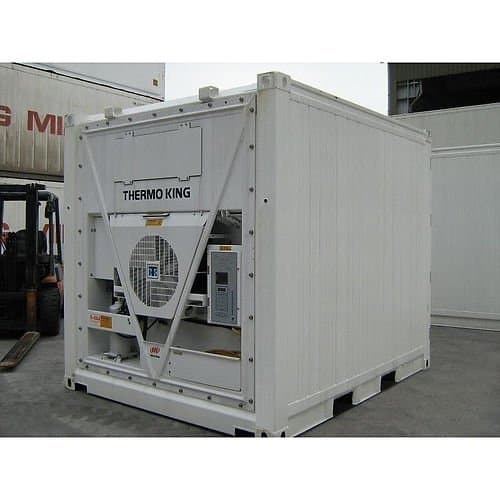
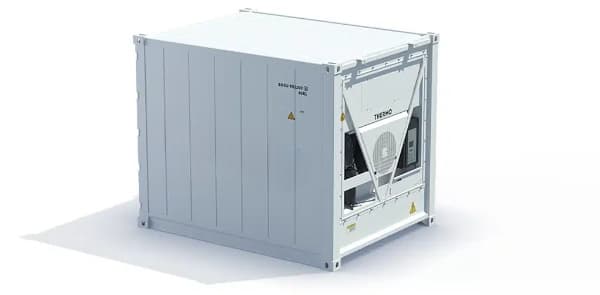
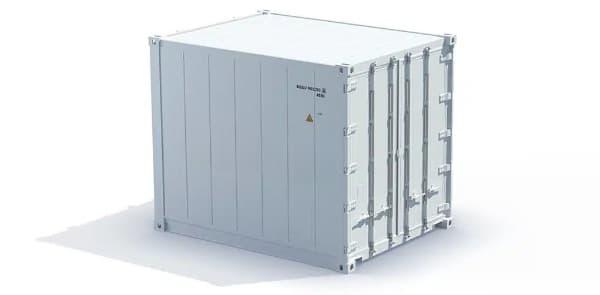
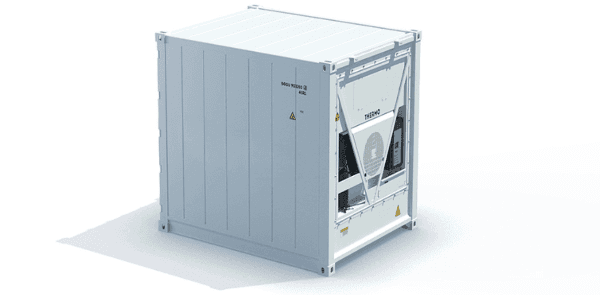
The new 20ft High-cube refrigerated container is a temperature-controlled transport and storage unit, designed to meet the needs of professionals handling goods sensitive to heat or cold. Its design complies with ISO standards applicable to maritime containers (ISO 668 for dimensions and ISO 1496-2 for refrigerated containers), ensuring compatibility with international transport infrastructure. This model stands out with an internal height greater than that of a standard dry container, offering additional usable volume for loading. The structure is made of Corten steel, an alloy known for its corrosion resistance, with injected polyurethane foam insulation ensuring lasting thermal performance. The walls, ceiling and floor are designed to minimise thermal bridges and maintain a uniform temperature inside, even when external conditions vary. The integrated refrigeration unit runs on three-phase power and allows precise temperature regulation, with a stated range of -35°C to +30°C. This amplitude covers both deep freezing and chilled holding, making the unit versatile for many applications. The refrigeration system is housed in a technical cavity at one end, accessible for maintenance. Operation is optimised to limit energy consumption and reduce noise emissions, an important point for installations in urban areas or near residential zones. The access door is of the Easy Open Butchers type, fully lockable, which facilitates loading and unloading operations while ensuring the security of the contents. Inside, plastic strip curtains help limit air exchange during frequent openings, thus preserving thermal stability. The floor is flat, without grooves, to allow easy manoeuvring of trolleys and pallet trucks. LED light strips are integrated into the ceiling to uniformly illuminate the workspace. A panic alarm device, known as a "man trap", is present to signal any accidental presence inside when the door is closed. An access ramp is available as an option to facilitate loading from the ground. This new refrigerated container is delivered with a pre-trip inspection (PTI) certificate carried out before delivery, attesting to its proper functioning. It is wind and watertight, an essential characteristic for protecting goods from bad weather and humidity. The T-floor, typical of reefer containers, allows air circulation under pallets, promoting uniform temperature distribution. This model is particularly suited to transporting fresh or frozen food products, pharmaceutical products requiring a strict cold chain, cut flowers, sensitive chemicals or electronic equipment that must be protected from thermal variations. It can also serve as a temporary storage unit on a construction site, at an event or on a farm, thanks to its robustness and its ability to maintain controlled climatic conditions. In France, the use of a refrigerated container for transporting perishable foodstuffs is governed by cold chain regulations, notably the decree of 21 December 2009 on sanitary rules applicable to retail trade activities, and by the international ATP agreements (Agreement on the International Carriage of Perishable Foodstuffs and on the Special Equipment to be Used for such Carriage). For road transport, the container must comply with ATP requirements if it is used for perishable foodstuffs under controlled temperature. It is recommended to check the ATP approval of the refrigeration unit and to ensure that the unit has a valid certificate if it is intended for this type of transport. For installation, a three-phase power supply suited to the unit's power should be provided, along with a flat, stabilised surface. Regular maintenance of the refrigeration system, including cleaning condensers, checking refrigerant levels and inspecting seals, helps maintain performance and extend the equipment's lifespan. Periodic testing of alarms and safety devices is also advised. At purchase, it is important to check the general condition of the structure (absence of perforating corrosion, major impacts), the proper functioning of the unit under real conditions, the presence of certificates and the maintenance history. The payload capacity and tare weight vary according to the exact configuration; it is recommended to refer to the container's nameplate. External dimensions are 6060 mm long, 2438 mm wide and 2890 mm high, corresponding to a 20ft high-cube format. The stated internal dimensions are 5870 mm long, 2330 mm wide and 2591 mm high, offering an internal volume of approximately 33 m³. White is standard for this type of unit, facilitating solar reflection and integration into varied environments. This new refrigerated container represents a durable solution for companies seeking to control the temperature of their products throughout the logistics chain, with the possibility of fixed or mobile use. It can be placed on the ground, on a trailer or integrated into a logistics platform. Its modular design also allows specific fittings, such as adding shelving or partitions, provided that air circulation is not compromised. In summary, this new 20ft High-cube refrigerated container combines robustness, thermal performance and safety equipment to meet the requirements of refrigeration professionals.
To go further in using this container, it is useful to examine in detail good operating and maintenance practices, regulatory constraints depending on use, and selection criteria compared with other formats or types of containers. This section complements the technical presentation and aims to provide professional buyers with the necessary benchmarks for smooth and compliant operation.
Routine care and preventive maintenance. A refrigerated container is mechanical equipment that requires regular monitoring to maintain its performance. The refrigeration unit should be inspected at least once a year by a qualified technician, and more frequently in case of intensive use or in a dusty environment. Preventive maintenance operations include cleaning the exchangers (condenser and evaporator) with compressed air or water, checking the condition of belts and fans, verifying the tightness of the refrigerant circuit, checking operating pressures and temperatures, and testing sensors and thermostats. Door seals and gaskets should be examined regularly: wear or hardening can cause infiltration of warm, humid air, leading to excess consumption and frost formation. The T-floor must be kept clean: the grooves must not be obstructed by debris, as this would impair air circulation under pallets. Periodic cleaning with hot water and a detergent suitable for stainless steel or aluminium is recommended, followed by careful rinsing. For food uses, cleaning and disinfection protocols compliant with current hygiene rules must be applied. The panic alarm system and LED lighting should be tested at regular intervals. Finally, it is advisable to keep a maintenance log recording interventions, temperature readings and any incidents; this document may be requested during sanitary inspections or when reselling the equipment.
Regulations and compliance in France and internationally. Beyond the ATP already mentioned, several texts govern the use of refrigerated containers. For road transport of perishable foodstuffs, the decree of 21 December 2009 sets sanitary rules applicable to retail trade activities, while Regulation (EC) No 852/2004 on the hygiene of foodstuffs imposes obligations for cold chain control. The transport of products of animal origin may fall under Regulation (EC) No 853/2004. For pharmaceutical products, Good Distribution Practices (GDP) require qualification of cold equipment and temperature mapping, with continuous recording. The use of a refrigerated container as a fixed cold room may be subject to local planning requirements, particularly if the unit is permanently installed on private land: it is prudent to check with the town hall on prior declaration rules. Regarding electrical safety, the installation must comply with NF C 15-100 for low-voltage installations, and connection must be carried out by a qualified professional. Refrigerants used in modern units are subject to Regulation (EU) No 517/2014 on fluorinated greenhouse gases, which requires periodic leak checks and traceability of interventions. It is therefore important to keep intervention certificates and ensure the technician holds a competence certificate for handling refrigerants.
Sector use cases. In the agri-food sector, this container can be used to store meat, fish, dairy products, fruit and vegetables, or prepared dishes, whether upstream of production or downstream for distribution. Agricultural cooperatives use it to store sensitive crops or seeds requiring a stable temperature. In the fisheries sector, it allows fish products to be kept on board vessels or on quays, subject to a suitable power supply. The pharmaceutical sector sees it as a way to comply with the cold chain for vaccines, medicines and biological samples, with temperature recording. Analytical laboratories and research centres can store reagents in it. In the events sector, caterers and festival organisers use refrigerated containers as temporary storage units for food and beverages. Florists and horticulturists keep cut flowers at a temperature between 2°C and 8°C. The chemical industry can store products requiring controlled temperature, subject to compatibility with interior materials. Finally, individuals or craftsmen can rent this type of container for moving sensitive products or for a renovation project requiring a temporary cold room.
Comparison with other container sizes and types. The choice of a 20ft High-cube refrigerated container should be put into perspective with other solutions. A 40ft High-cube refrigerated container offers about double the internal volume (approximately 67 m³) and allows more pallets to be transported, but it is heavier, bulkier and requires higher refrigeration power. It is suited to large volumes and long distances, while the 20ft is more manoeuvrable, easier to move and suitable for medium flows or fixed installations. A standard 20ft dry container has a lower internal height (about 2390 mm) and does not regulate temperature; it is reserved for non-sensitive goods. An open top or flat rack container is designed for out-of-gauge loads, without insulation. A standard reefer container (non-high-cube) has an internal height of about 2390 mm, i.e. about 200 mm less than the high-cube, which can limit pallet stacking. The high-cube refrigerated container is therefore an interesting compromise between usable volume and external compactness. Finally, modular cold rooms made of sandwich panels offer superior insulation and greater customisation, but they are less mobile and are not designed for maritime transport. The refrigerated container, on the other hand, remains intermodal equipment, stackable and transportable by sea, road or rail.
Points to watch when purchasing. When acquiring a new refrigerated container, it is advisable to check the unit's compliance with current standards, the presence of the PTI certificate, any manufacturer's warranty and delivery conditions. For a used container, inspection must be even more rigorous: looking for corrosion, operating test over several hours, checking welds, examining the floor and interior walls. The payload capacity depends on the container's tare weight and maximum authorised weight; this information appears on the CSC plate (Convention for Safe Containers). It is also recommended to check the compatibility of the supply voltage with the installation site's network (three-phase 380-460 V depending on models). Finally, the location should be chosen taking into account access for handling equipment, ventilation around the unit and protection from extreme weather.
Conclusion. This new 20ft High-cube refrigerated container is a reliable and versatile solution for professionals requiring precise temperature control. Its robust design, safety equipment and compliance with international standards make it a durable investment, whether for transport, fixed storage or event applications. Regular maintenance and compliance with applicable regulations allow it to be fully exploited over the long term.