Description
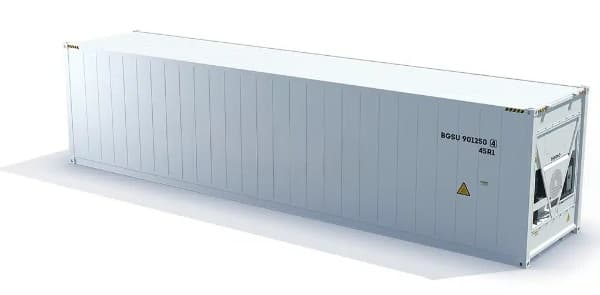
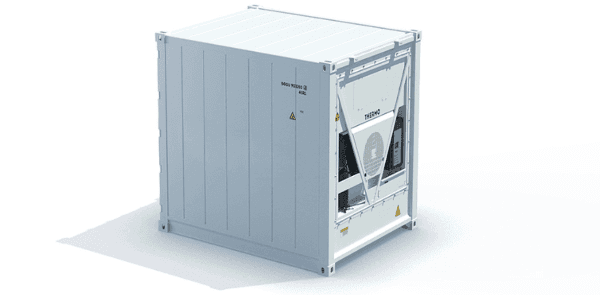
The 40ft High Cube refrigerated container is a temperature-controlled transport and storage unit designed for goods that cannot withstand temperature variations. It follows the architecture of an ISO maritime container, but incorporates a refrigeration unit and an insulated envelope that maintain a constant temperature setpoint, both in positive cold for preservation and, depending on the model, in negative cold for freezing. Its greater internal height compared with a standard dry container makes it a popular solution when extra usable volume is needed without increasing the footprint.
This model offers an internal volume of 68.2 m³, placing it among the most capacious in the 40ft family. The overall dimensions given are 1219 cm long, 244 cm wide and 259 cm high, with a tare weight of 4650 kg. These values correspond to the standard dimensions of 40ft High Cube ISO containers: 40ft length (about 12.19 m), 8ft width (about 2.44 m) and 9ft 6in height (about 2.896 m). The difference between the stated height and the ISO height is due to the measuring method: depending on whether the box alone or the box plus refrigeration unit is measured, the total height varies. In all cases, allow sufficient ground clearance and space for installing the unit and opening the doors.
The structure uses Corten steel, a low-alloy, high-yield-strength, self-weathering steel that resists atmospheric corrosion thanks to the protective oxide layer that forms on its surface. It is the standard material for maritime container construction, valued for its robustness and durability outdoors. The walls, roof and doors are lined with insulation (rigid polyurethane foam in most refrigeration units) sandwiched between two steel sheets, which limits thermal bridges and reduces losses. The floor is made of 28 mm marine plywood, a dense panel treated to withstand moisture and rolling loads; it is usually completed with aluminium T-profiles that channel cold air under pallets and ensure even circulation throughout the cargo.
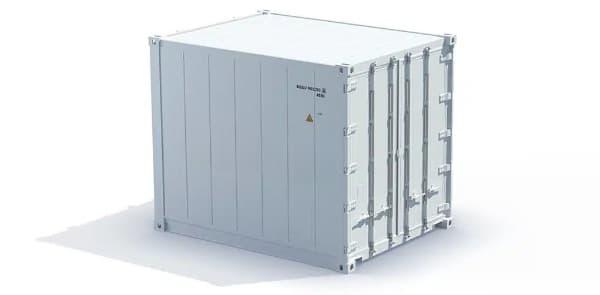
The rear doors are double-leaf, fitted with container locks (vertical locking bars and operating handles) and peripheral seals. On a refrigerated container, these seals play a critical role: they prevent the ingress of warm, humid air, which causes condensation, frost and excessive unit consumption. It is therefore essential to inspect them regularly and replace them as soon as they harden, deform or show cracks. Likewise, condensate drains must remain clear: a blocked drain can cause water to accumulate on the floor and damage the cargo.
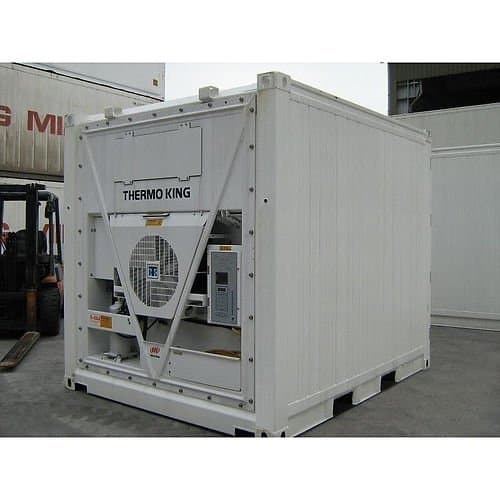
The integrated refrigeration unit operates over a setpoint range of approximately -30 °C to +30 °C, covering positive cold preservation (fresh produce, fruit and vegetables, chilled meat, dairy products, cut flowers) as well as negative cold (frozen goods, ice cream, pharmaceuticals requiring a strict cold chain). Regulation is provided by an electronic thermostat and a cyclic defrost system. Depending on the equipment, the unit can be powered by three-phase 380-460 V or single-phase 220-240 V, at 50 or 60 Hz; connection must be carried out by a qualified professional, with residual current protection and a cable suited to the starting current. A refrigerated container consumes energy continuously when in operation: provide a stable power supply and, if the unit is installed on a remote site, a backup solution or generator.
In terms of transport, this container complies with ISO 668 (dimensions and masses of series 1 containers) and ISO 1496-1 for handling and securing containers, as well as the specific requirements for refrigerated units (ISO 1496-2). It can be handled by standard port terminal and logistics platform equipment: crane spreader, reach stacker, heavy forklift or side-loader. The standard corner fittings allow securing on ship, railcar or road chassis. In France, road transport of a loaded 40ft container is generally carried out on a container chassis towed by a heavy goods vehicle; the gross vehicle weight must remain within the limits of the Highway Code and the accompanying documents (consignment note, dangerous goods declaration where applicable) must comply. For animal products or products of animal origin, transport under controlled temperature is regulated and may require health approval and a temperature record; check with the competent veterinary services before shipping.
When buying, several points deserve careful checking. First, the condition of the refrigeration unit: request a load test, a temperature record over several hours and, if possible, a recent maintenance report indicating the condition of the compressor, condenser, evaporator and refrigerant charge. Second, the condition of the box: check for impacts on the walls, perforating rust on floor rails and posts, and roof deformation. Check the integrity of the door seals, the operation of the locks, the presence of the four upper and lower corner fittings, and the absence of undeclared structural repairs. A new refrigerated container, such as this one, does not have these defects, but preventive maintenance remains the key to its longevity.
On-site installation requires some precautions. The container must be placed on flat, stable ground capable of bearing the distributed load (tare weight of 4650 kg plus the weight of the cargo, which can reach several tonnes). A slight excavation or concrete pads prevent settling and facilitate water drainage. Leave free space in front of the doors for handling, and above all sufficient clearance around the refrigeration unit for hot air discharge: a unit boxed in against a wall or under a poorly ventilated canopy loses efficiency and may trigger overheating alarms. Outdoors, the unit is exposed to sun and rain; shade and natural ventilation reduce power consumption. Indoors, ensure the hot air discharged by the condenser is extracted.
Uses are varied. In food logistics, the 40ft High Cube refrigerated container is used for buffer storage at depots, intermodal transport and shipment of full pallets. In the pharmaceutical and cosmetics sector, it allows thermosensitive products to be kept at controlled temperature, subject to compliance with good distribution practices and applicable regulatory requirements. For events, it can serve as a mobile cold room for catering, festivals or markets. In agriculture, it is used for pre-cooling and preserving fruit and vegetables after harvest. Finally, some professionals use it to store samples, flowers, seeds or sensitive chemicals.
Routine maintenance includes regular cleaning of the evaporator and condenser, checking pressures and refrigerant charge, verifying correct defrost operation, cleaning drains and inspecting door seals. It is recommended to keep a maintenance log and temperature records, useful for traceability and for anticipating breakdowns. A preventive maintenance contract with a qualified refrigeration engineer remains the best way to avoid costly downtime. When empty, the container can be switched off, but it is better to leave the doors ajar to avoid odours and condensation, after cleaning and drying it.
From a regulatory standpoint, the use of refrigerant is governed by European regulations on fluorinated greenhouse gases: installation, maintenance and recovery of the refrigerant must be carried out by operators holding a competence certificate. Placing a refrigeration unit on the market and operating it may also be subject to periodic leak-check obligations depending on the refrigerant charge. Finally, if the container is used as a workplace (site office, workshop), applicable health and safety rules must be respected, particularly regarding ventilation and lighting.
To go deeper into maintenance, it is useful to distinguish three levels of intervention. The first is daily or weekly maintenance, which can be carried out by the operator: visual check of the unit, verification that the evaporator fan is running, observation of the displayed temperature, listening for abnormal noises, cleanliness of grilles and absence of excessive frost. The second is half-yearly or annual preventive maintenance, entrusted to a refrigeration engineer: measurement of high and low pressures, checking subcooling and superheat, checking circuit tightness, testing safety devices (pressure switch, thermal protection, temperature sensor), deep cleaning of heat exchangers, checking tightness of electrical connections. The third is corrective maintenance, triggered in the event of a breakdown: replacement of a fan, sensor, contactor, refrigerant recharge or compressor replacement. Anticipating these interventions through an annual contract avoids downtime during peak periods, especially in summer for preserving fresh produce.
An often overlooked point is humidity management. When the doors of a cold container are opened in hot, humid weather, outside air enters and its water vapour immediately condenses on the cold walls and on the cargo. This causes frost on the evaporator, water on the floor and can damage cardboard or packaging. To limit it, open the doors for as short a time as possible, prepare pallets in advance, use an airlock or strip curtain if needed, and check that defrost is working correctly. Cleaning drains and collection trays is one of the simple actions that prevent many problems.
Another point of vigilance concerns loading. A refrigerated container does not instantly cool goods that enter at ambient temperature: it maintains a temperature, it does not create it. Products must therefore be loaded already at the correct temperature, without leaving pallets against the walls or in front of the air outlets, and without obstructing the air return at the bottom of the doors. Respecting the air circulation space under the pallets, above the cargo and on the sides is decisive for thermal uniformity. Loading that is too dense or poorly arranged creates invisible hot spots, where goods can deteriorate without the unit's thermometer signalling it.
Comparing with other container sizes and types helps in choosing the right format. A 20ft refrigerated container offers about half the volume and is suitable for small shipments or sites with limited length; it is also lighter and easier to handle. The standard 40ft (dry) is lighter and cheaper, but offers no temperature regulation: it is suitable for dry storage, modular housing or transport of non-sensitive goods. The 40ft High Cube dry adds usable height without a refrigeration unit, making it a good choice for pure volume. The 40ft High Cube reefer container, the subject of this sheet, combines both advantages: large volume and controlled temperature. Conversely, an open top or flat rack container is preferred for out-of-gauge loads or goods that must be loaded from above or from the side, but they are not designed for cold. Finally, a standard 40ft reefer container (non-High Cube) remains an option when available height under ceiling or gantry is limited.
The choice between buying and renting depends on use. For a one-off, seasonal or site-related need, rental avoids tying up cash and heavy maintenance. For recurring use, permanent on-site storage or a trading activity, purchase becomes more economical in the medium term, especially as the resale value of maritime containers generally remains decent. In both cases, the budget must include the cost of energy, maintenance and, where applicable, delivery and installation by crane or truck-mounted crane.
Finally, a few sector-specific use cases illustrate the potential of this container. In food distribution, it serves as remote cold storage at the back of a shop or central kitchen. In fishing and the meat sector, it provides temporary preservation before shipment under controlled temperature. In horticulture and floriculture, it keeps cut flowers and plants at a stable temperature before sale. In pharmacy and biology, it can hold products requiring a defined temperature range, subject to qualification and traceability. For events and catering, it acts as a mobile cold room for buffets, festivals or film shoots. In industry, it stores glues, resins, paints or chemicals sensitive to frost or heat. This versatility explains why the 40ft High Cube reefer remains one of the most in-demand formats on the specialised container market.
In summary, the 40ft High Cube refrigerated container combines the volume of a large High Cube container with the precision of an integrated refrigeration system. It is aimed at professionals in the cold chain, logistics, food processing, pharmaceuticals and events looking for a robust, standardised and durable solution for temperature-controlled transport and storage. Before buying, check the site's power supply compatibility, access for delivery and handling, and the operating budget linked to the unit's consumption. A well-maintained and correctly installed container offers years of reliable service.